
High Employee Attrition Explained: Why It Happens and How to Stop It

WHAT’S INSIDE
I want CliQ Updates!
High attrition is a serious workforce challenge that many organizations have underestimated. Sometimes referred to as “the churn,” it drains productivity, knowledge, and morale, leaving leadership trapped before they can realize what’s happening.
Employees will always leave, no matter how strong your compensation or benefits are. According to AIHR, 62% of HR professionals say that their biggest workplace challenge is to retain employees. No matter what a company might appear to offer on the surface, whether they offer competitive compensation or a great set of benefits, some employees are going to want to leave. It could be due to a workplace dispute, for better opportunities, or for a change in life circumstances. There truly is no one reason why someone might choose to leave.
However, if we aren’t hiring new employees to replace the leavers, what does that mean for the company? This metric of employee departures and a shrinking workforce is referred to as high attrition, and it can lead to some serious consequences for any organization not willing to address it.
What Is High Attrition?
Attrition is the reduction of a workforce without immediately filling the vacancies caused by leaving employees. It could be very gradual as various posts become empty, or it could be sudden. However, it is usually categorized as being voluntary rather than forced, as we might see with layoffs and dismissals. Common reasons for attrition include:
- Retirements
- Resignations
- Deaths
- Internal mobility
- Elimination of defunct positions
It can be considered to be high attrition when a significant portion of the staff has left without being replaced, or if many of them decide to all leave at the same time.
What Are the Types of Attrition?
Even though attrition itself is a passive action, it can still be categorized in different ways:
- Voluntary attrition – When employees choose to leave their positions without being replaced, such as through retirement or internal attrition, like a promotion
- Involuntary attrition – When an organization chooses to terminate positions with no plans to replace employees, for reasons such as restructuring or performance-related issues
Attrition vs Turnover vs Layoffs
As we mentioned earlier, attrition is usually thought of as being voluntary. Voluntary attrition is usually connected to employees submitting their resignation rather than some other trigger being the reason why they leave. This is different from turnover and layoffs.
Employee turnover typically sees new hires being brought in to replace departing employees. Think of it as the overall number of bodies on a team remaining the same while the faces change, whereas employee attrition sees no replacements brought in.
Layoffs are a form of involuntary turnover that happens when an organization decides to terminate employees. This is a deliberate action and usually comes about as a result of economic downturn or business restructuring.
Remember, attrition is passive; turnover and layoffs are active. Though they can all result in a workforce shrinking, attrition usually happens without direct action.
Why Should You Track Attrition Rate?
Though your employee attrition rate might seem like just one more metric to track, it is incredibly important to keep an eye on it. A high turnover can be bad for employee morale as those who stay watch people come and go constantly. Employees may feel a great deal of instability as their teams change from month to month.
Attrition can be worse.
Employees watch as their teams actively shrink around them, and they will respond accordingly. By keeping an eye on your attrition rate, you get a clear insight into your current workplace culture and the overall health of your company, especially through issues such as:
- Low productivity
- Employee dissatisfaction and disloyalty
- Recruitment problems
- Poor company culture
- Work-life imbalances among employees
How to calculate your attrition rate
You can easily calculate the attrition rate of your organization using this formula:
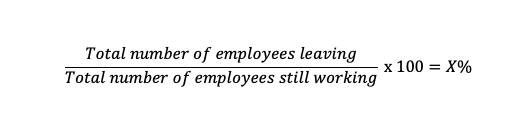
A high attrition rate is generally one that is considered to be above 10%, though this may change from sector to sector. Some industries, like tech and hospitality, frequently see high levels of turnover and intense competition. As a result, they will have higher attrition rates than those in government or healthcare, where rates may be more stable.
How Does Attrition Affect a Company?
It seems like nothing you do can stop people from leaving. For every initiative you introduce, people still continue to leave, and that attrition rate just keeps on climbing. How is this going to affect the company on a wider level? Management may witness some of the following impacts coming into play:
Loss of expertise
When you lose the one person who is capable of doing a certain specific task, what do you do? It may not simply be a case of bringing in a new hire to replace them; you might not be able to find anyone with the same experience and knowledge as the outgoing employee. Without good mentoring and knowledge management in place to preserve knowledge and pass it between coworkers, attrition can erode team knowledge.
Increased recruitment costs
Recruitment can be expensive enough as it is, with the average cost per hire being approximately $4,700. However, attrition means that no one is stepping in to fill empty roles, so HR needs to spend more time and resources searching for potential candidates. At the same time, they also need to increase their budgets and resources for employee retention, to ensure those who stay behind also aren’t inclined to leave too.
Non-existent company culture
Your company culture is formed by the people who live and breathe it. How can they maintain it if they leave? If there is no company culture to engage with in the first place, people may feel uncomfortable speaking out and trying to set up something themselves. They will not want to set up community and partnerships with people who might not even be there next week.
Burnout
Burnout is a real and serious issue that can cause a major impact on workforces. With high levels of attrition in place, those who decide to stay often find their workloads increasing because someone has to take on those tasks. An increase in responsibilities and workload with corresponding benefits and compensation is just a recipe for burnout.
How Leaders Can Actively Reduce High Attrition
So, what can be done to reverse high attrition? It is not as simple as snapping your fingers and hiring a bunch of new faces, as there is a reason why people are leaving in the first place. Instead, the focus needs to be placed on your workplace culture and environment. When you create a place that people want to be a part of and would be sorry to leave, they will want to stay and thrive. And when they stay and thrive, you don’t need to worry about them leaving gaps behind them, as you can hire new staff even if they move up within your organization.
1. Start career conversations early
Let’s be real, very few people spend their entire life working for the same organization. Rather than pretend otherwise, it is more productive for management to have career conversations with their employees.
Doing so can help to inform professional growth and development decisions early. Find out how an employee’s professional goals align with those of the wider company, and build a path together that allows them to contribute to the organization while also building their career as they best envision.
2. Offer good compensation
OK, let’s start by paying your employees what they are worth. It’s simple, and yet so often overlooked.
However, you need to think about more than a paycheck. You also need to ensure that you are offering a full compensation package that goes beyond the amount paid into someone’s bank account. PTO, health insurance, remote work options, all of these and more can make for attractive compensation packages.
3. Build support networks and belonging
Your employees need to know that they belong in your company. They are not just another face in a team picture or name in an email list; they are an individual who should be valued and trusted. Part of this is ensuring that an employee feels like they have support to turn to, whether they are struggling or thriving.
Employee resource groups, or ERGs, are a great way to nurture these connections. Depending on the size of your company, some employees may never get to meet coworkers with the same characteristics as them. Connecting with an ERG gives people the chance to build connections with like-minded people and find solidarity when they otherwise might feel alone. And when organizations support the creation and administration of ERGs, employee communities are given the chance to thrive.
4. Strengthen leadership and development tracks
Many leaders feel like they are catapulted to positions of power suddenly and with no support in place to help them ease into the position. If they are given no support, they can feel overwhelmed, and this could ultimately cause them to burn out and leave. If the company then doesn’t replace them but instead breaks their team up to be absorbed by others, this results in attrition.
This can be countered by introducing leadership and development tracks and identifying high-potential candidates early and well before they receive their promotions.
5. Encourage a strong work/life balance
It doesn’t matter how busy you think your industry is or how switched on everyone needs to be; not everyone needs to be chained to their desks 24/7. Did you know that 1 in 10 Americans feels very inclined to answer work emails and messages while on PTO? This shouldn’t be the norm.
Unfortunately, a strong work/life balance is one of those things that needs to be top-down. Management needs to be the ones championing sticking to working hours and focusing on productivity within working hours. If they are the ones calling for long hours without fair compensation or reasonable adjustments, they are only going to burn out their workforce and cause them to leave.
6. Champion feedback and recognition
When was the last time you heard you did a good job at work? Though we can’t expect praise for every little thing we do, we should offer feedback and recognition when it is deserved. Formal recognition programs are a great way to start this, but informal feedback and small shoutouts can be of equal importance.
Make sure to build out your feedback channels in multiple directions rather than just passing it from management down. Peer and upward feedback can be just as valuable as hearing critiques from your manager.
7. Be open to boomerang employees
Some employees leave and then come back again just a few months later. The grass always appears to be greener on the other side after all. These boomerang employees need to be welcomed back and allowed to align with the company once more. After all, they might have picked up some valuable skills in their time away that could be of benefit now.
When any employee leaves, don’t slam the door behind them. Badmouthing them to team members who may still be in contact with them—or even worse, on your personal or company’s social media—is never going to bring them back and will only add to your attrition rate.
Build a Culture of Belonging With Mentorcliq
Ultimately, a high employee attrition rate cannot be fixed with employment drives or company restructuring. Unless you fix the reasons why people are leaving, you will not see any changes to the levels of attrition you see.
Build a culture where employees choose to stay.
Employees need to feel like they belong and like they have a purpose within the company. Management needs to ensure there are opportunities to connect at every level. When employees feel like they are part of a collective rather than an isolated afterthought, they will be less inclined to think about moving on. Making use of groups like ERGs provides easy internal networking and helps to build connections among workers who otherwise might not have a chance to meet.
Want to manage your ERGs and employee communities but worried about the administrative burden this could place on your leaders? You need MentorcliQ’s mentoring and ERG software, designed to help you engage every level of your employee communities.
Book a demo to see how our ERG management software today helps you reduce attrition and empower your employee communities.
Modal