
How to Prove Mentoring ROI: Lessons from the City of Fort Collins’ Data-Driven Talent Strategy
WHAT’S INSIDE
I want CliQ Updates!
ROI is the common (unavoidable) truth for HR and L&D leaders launching new programs. Mentoring programs are no different. Executive leaders will demand to see how any employee development, engagement, and retention initiative is adding value to the bottom line. If you can’t prove mentoring ROI, you’ll be hard-pressed to get budget to continue or expand programs.
The solid truth is that mentoring works, and exceptionally well when properly implemented. Still, budget pressure is rising. Talent needs are evolving. Leadership teams want evidence, not anecdotes.
The good news is that organizations can quantify the ROI of mentoring. Few do it better than the City of Fort Collins, a MentorcliQ customer whose data-backed approach offers a blueprint any organization can follow.
As Christine Arnott, Talent Development Manager for the City of Fort Collins, shared during a recent MentorcliQ webinar:
“Our business goals are all rooted around our mission, vision, and values. We look at everything we do and ask, ‘How does this help us serve our community better?“
The City of Fort Collins launched a mentoring program that was measurable, scalable, and reached employees across more than 50 departments. Their story reveals exactly how HR teams can use mentoring to drive engagement, retention, mobility, cultural transformation, and employee well-being, even when strained budgets start rearing their ugly head.
The Problem? HR Knows Mentoring Matters, But Proving Its Value Is Hard
HR teams know well that mentoring matters and that it works. Our own data backs this up. In our Mentoring Impact Report, we found that companies with mentoring programs report 2X the profit of those that don’t. This generally comes down to the fact that mentoring boosts productivity, development, and retention, ultimately adding to the many other people strategies that make a company more profitable.
Grab the Mentoring Report Infographic:
Nevertheless, proving value remains a challenge for leaders, particularly when launching a new program. When you don’t have data on hand, you have to rely on third-party data to prove your point and make a compelling case. That can often be… difficult, particularly when executive leaders want to contextualize the proof.
Many HR and L&D teams face the same challenge:
- Employees want development opportunities
- Leaders want clear ROI
- HR wants scalable, sustainable ways to deliver both
Before adopting MentorcliQ, Fort Collins had a grassroots mentoring initiative run through an employee resource group (ERG). The passion was there, but administrative burden and limited data made it hard to scale or measure impact.
Christine reflected:
“We moved from a Google form and spreadsheet to something much more robust. What took a five-person team three weeks now takes my small but mighty team a fraction of the time.”
This is the problem many HR leaders feel daily: The program has potential, but the infrastructure doesn’t match the ambition.
Talent Needs Are Diverse, and One-Size-Fits-All Approaches Often Fail
Differentiation is a key to success with any development program. This is one of the many areas where I’ve found alignment in education for both adults and children. During my nearly 10 years teaching in high school, differentiation was often the difference that ensured a majority of students succeeded at the end of the year. Students come in at very different levels of knowledge, so a single-approach lesson may be too difficult for some, and too easy for others.
The problem with most approaches to education, whether for children or adults, is that there’s a tendency to teach to the middle. That’s usually out of convenience, not data. There often isn’t an actual “middle.” There’s a distribution of knowledge and experience that’s rarely ever bucketed so easily.
Consequently, that’s where HR and L&D leaders often land with development programs. While there’s a core set of knowledge every employee needs to know for their role, effective development is personalized to the employee. And that isn’t easy without giving employees more control over their own growth.
The City of Fort Collins employs nearly 3,000 people across wildly different roles, from utilities to natural areas to the children’s museum to transit.
Christine framed it perfectly:
“One size cannot fit all. One size fits one.”
This challenge isn’t unique. Across industries, workforces are increasingly:
- Hybrid and remote
- Multigenerational
- Cross-functional
- Spread across time zones or shift schedules
Mentoring is powerful, but only when it’s flexible. This is where the City of Fort Collins recognizes the need for differentiation. Mentoring programs succeed on this end, but only when the matching strategy is dynamic and avoids manual biases common to manual matching, which undermine the effectiveness of matching mentors and mentees.
Fort Collins created one program with many paths: structured mentoring, coaching-style mentoring during COVID, flexible commitment models, and the freedom for each pair to shape their partnership.
The takeaway for HR leaders? Personalization is no longer a perk; it’s a requirement.
Real-World Examples: How Mentoring Transformed Employees and Culture
Fort Collins’ program is steeped in powerful qualitative stories backed by quantitative impact. Here are two examples Christine shared:
1. A first-time mentor discovers her leadership potential
Christine recalled encouraging a colleague to mentor for the first time:
“I said, ‘Here’s what I see in you.’ She didn’t think she could do it.”
Chrinstine’s story highlights how this colleague became an effective mentor and gained the confidence to pursue and secure a leadership role at a different company shortly afterward.
Even better: She later boomeranged back to the organization and continued to lead major change.
As a boomerang employee myself (I left MentorcliQ in 2024 after 3 years to pursue a new leadership position opportunity and returned in 2025), this story resonates with me on a personal level. Boomerang employees are proof that something about your organization works. Employees only return if they feel the organization still has something to offer.
When that “something” is effective development, it’s far more likely to encourage employees to return. Development remains an uncommon benefit that many companies still struggle to get right. Those that do get it right are far less likely to lose employees in the first place, and far more likely to get them to come back when they leave.
This is a textbook example of mentoring enabling:
- Leadership pipeline development
- Boosted confidence
- Long-term retention
It also offers a very valuable lesson that HR and L&D leaders can lean into when building programs or defending the budget for program expansion and software.
2. A retiring department director could trace his entire career through mentoring
Another story came from a long-tenured director:
“He was able to name who his mentors had been over the years—and how mentoring shaped him.”
This reflects what research repeatedly confirms:
- Individuals with a mentor rate their company’s career advancement opportunities 2X better than those without one, according to a CNBC/SurveyMonkey poll.
- Employees actively involved in mentoring have a 50% higher retention rate than those without it (based on MentorcliQ data)
Stories like these are anecdotal (yes, a terrible word in isolation), but are supported by a growing body of data that reflects the measurable impact Fort Collins observed.
The Mentoring ROI: How Fort Collins Uses Data to Justify (and Expand) Mentoring
We’ve covered why mentoring is valuable and why the City of Fort Collins has found value in it. But the real gold you’re mining for here is not so much the “why” of mentoring, but the proof of mentoring success, which comes in the form of return on investment.
Here’s where the City of Fort Collins stands apart in one key area where MentorcliQ comes alongside them: their ability to quantify outcomes.
Christine shared several meaningful metrics:
1. Higher Retention
“Mentorship participants had 1.5% higher retention than the organization-wide average.”
Even a small lift in retention leads to significant savings, depending on the cost to replace employees. The City of Fort Collins came to MentorcliQ in 2022, following a year of heavy turnover related to the Great Resignation, especially among leadership, where turnover was 30%.
For a city like Fort Collins, where budgets can be tight and highly dependent on shifting political, 1.5% can add up to hundreds of thousands of dollars in savings. That’s enough to impact continuing or dropping different citywide programs.
That 1.5% also only represents the difference in retention between mentorship program participants and the organizational average. Drilling down, the city’s mentoring program experienced 33% a reduction in turnover for participants vs non-participants, highlighting the targeted approach of its career development program.
Confused by the numbers? Let’s talk math
There’s a difference between an absolute lift in retention and a relative reduction in retention. Both are valid ways to assess the impact and ROI of a mentoring program. And the two numbers can appear very different, but are not contradictory because they measure two different things.
📌 Absolute lift (1.5%)
Shows the difference between mentorship participants and the entire org average — a broad, blended metric.
📌 Relative reduction (33%)
Shows the percent decrease in turnover compared strictly to the non-mentoring population.
When you compare two specific subgroups, you’ll always get a clearer and often larger effect size than when comparing one subgroup to the entire organization.
In other words:
The 1.5% number tells you the overall uplift.
The 33% number tells you the power of the program.
Both are valid, and together they tell a compelling ROI story for the City of Fort Collins.
2. Higher Engagement
“Mentorship participants had higher engagement in 12 out of 19 survey measures.”
Mentoring programs lead to 50% higher employee engagement and retention, according to an ATD survey of nearly 1,000 talent development professionals.
3. Massive Investment in Development
“This year participants tracked 900 mentorship hours and over 1,300 additional development hours.”
Mentoring sparks and accelerates learning in ways that are truly authentic and organic, far beyond what other learning strategies are capable of producing.
4. Broad Organizational Reach
“Over 70% of departments were represented in our mentorship program this year.”
Breadth matters. Widespread participation reduces silos and strengthens organizational culture.
Your Turn: Build a Quantifiable, Scalable Mentoring Strategy
The City of Fort Collins has carved out a successful strategy that’s allowed it to do what many companies have failed to do in the past: prove the value of mentoring enough to launch and grow its program, as well as defend its program when economic outlooks become rocky.
Based on the City of Fort Collins’ success, here are the key steps HR and L&D leaders should consider:
1. Pair a flexible program structure with strong guardrails
Effective program structure starts with consistency, clarity, and ease-of-use for program participants. If you reduce the friction involved in the process for mentors and mentees, they’re more likely to opt in, stay in, and engage more readily to reach their goals.
The City of Fort Collins uses:
- A clear start and end date
- Automated nudges
- Mid-year check-ins
- Resources embedded directly into MentorcliQ
This structure ensures consistency without restricting personalization.
Learn more:
➡️ How to Increase Mentoring Program Engagement
2. Use storytelling + metrics together when reporting to leadership
A good story goes a long way, especially when it’s backed by numbers. Quantitative data is a strong proof point, but you can emphasize it when you combine it with the power that comes with qualitative data (e.g., those anecdotes we keep warning you about).
Here’s the thing: anecdotes are indeed weak when they’re used in isolation. But when they’re used to put a human face on qualitative metrics, they deliver a powerful message to executive leaders who sometimes need a reminder that employee development should always be people-centric.
Christine frames it beautifully:
“Our stories complement our metrics. These two things fit together beautifully.”
Leaders need to see:
- Human impact
- Data trends
- Connection to business goals
This combined narrative is what ultimately secured future funding for Fort Collins’ program—even amid budget cuts.
3. Track metrics that tie directly to talent and organizational strategy
Talent development, mentoring included, always needs to connect to one or more organizational strategies and business goals. It can’t live in isolation from what your organization is trying to accomplish. At times, that’s as simple as “reduce overhead costs by increasing employee retention.” But there are times when your program strategy needs to connect to far more complex organizational strategies, such as upskilling employees to boost product development initiatives.
Key KPIs to replicate:
- Retention of participants vs. non-participants
- Engagement scores
- Leadership mobility
- Hours spent in development
- Cross-department participation
These metrics align naturally with HR priorities and organizational goals.
Learn more:
➡️ 3 Important Mentoring Program Objectives + How to Measure
4. Make participation easy with technology that reduces admin work
Companies like Fort Collins turn to MentorcliQ to automate the tedious, manual parts of running a mentoring program. Reducing admin work saves time and frees leaders up to work on other goals, including creating and launching strategies that enhance the program.
Even for programs as small as 100 participants, mentoring software can eliminate enough manual tasks to save program admins 180 hours of work a year. To determine how much money you’re saving your organization, just multiply your hourly equivalent by 180. For the average admin, this will equate to a 10X saving.
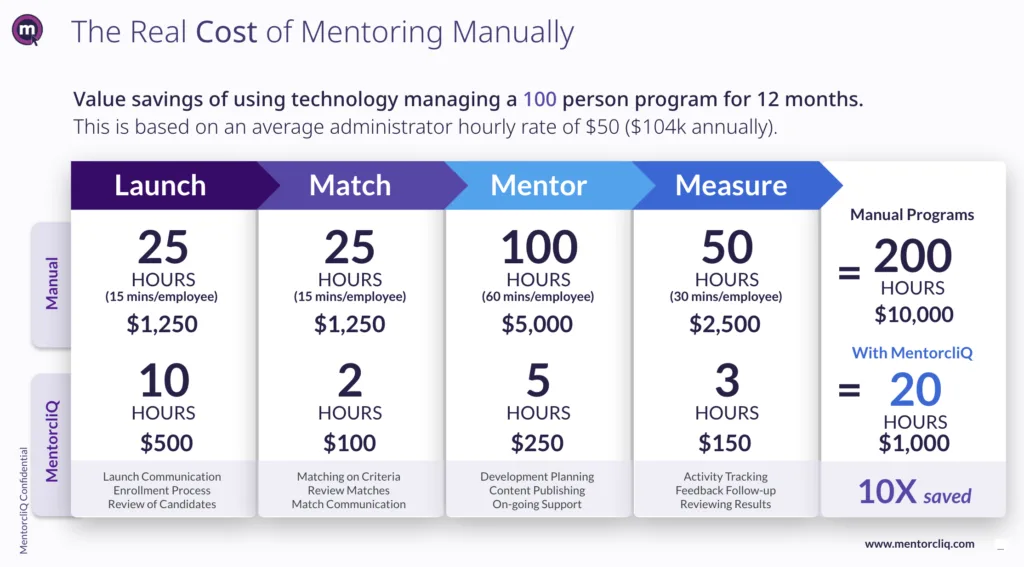
Christine highlighted this repeatedly:
“Anything that reduces administrative burden so we can stay focused on people—I’m here for it.”
Automated workflows, matching algorithms, reporting dashboards, and communication tools free HR teams to focus on strategy, not spreadsheets.
See for yourself with a quick demo and be sure to sign up for an upcoming MentorCom event!
5. Market the program through people, not just email
Mentoring is a people-led engagement and development strategy. Yet many leaders try to forget the “people” part when marketing internally to boost participation. Your people are an essential factor in building a sustainable program, and you can lean on their experiences to build interest in your programs.
Christine used this strategy in live info sessions by asking attendees how many people in the room had benefited in their careers from a mentor. As most of the room was standing, this created a powerful visual and reminder that being a mentor is just as important as being a mentee. A seemingly simple engagement helped the City of Fort Collins fill its mentor gap.
As Christine explained:
“It’s an entirely different thing for employees to see themselves in someone else.”
This type of grassroots-plus-strategic communication model dramatically increases program adoption.
Mentoring Is a Strategic Development Differentiator (When Done Well)
The City of Fort Collins demonstrates what’s possible when mentoring is treated not as an HR “program,” but as a core talent strategy supported by data, technology, and storytelling.
Organizations have many, many use cases for mentoring. This can include, but is not limited to:
- Improving employee engagement
- Increasing employee retention
- Build leadership pipelines
- Strengthen company culture and employee well-being
- Support diverse workforces
Mentoring offers one of the highest-leverage, lowest-cost pathways forward and can quickly deliver significant ROI, most notably at scale, where the cost per participant is low, while the revenue and cost-saving impact is high.
And as Christine put it:
“These small gestures create lasting impacts on careers and culture. We just need to shine a light on the evidence.”
If your team is ready to scale mentoring or prove its ROI more effectively, the City of Fort Collins provides a powerful blueprint. MentorcliQ is a piece of the puzzle that helps creative leaders turn manual development strategies into automated ROI.
Watch the Full Webinar with the City of Fort Collins
To hear Christine Arnott’s full story—including metrics, examples, and the exact strategies her team used—watch the complete webinar replay here:
It took just one demo for the City of Fort Collins to see that MentorcliQ was exactly what it needed to solve its critical retention and development needs. Book your own demo to see why it clicked after one look at the CliQ.
Modal