
What Is Apathy at Work: Stages, Signs, and How to Overcome

WHAT’S INSIDE
I want CliQ Updates!
If your job has gone from fun and motivating to something you have to force yourself through, then you may be facing workplace apathy. Merriam-Webster defines apathy as a “lack of interest or concern*.” Rightfully so, in a work environment, we’d like to describe it as a highway to career stagnation.
If you feel this way, you are not alone. This is a widespread problem, with only 21% of employees saying they feel engaged with their work, according to Gallup’s 2025 State of the Workforce report. The good news is that there is something you can do about it. Yes, even if you are experiencing chronic apathy!
Here, we explore what workplace apathy is, the stages and signs of apathy, and, most importantly, how to overcome it. Let’s jump in!
What is Workplace Apathy
There is a huge difference between occasional boring days and completely losing interest in your work. In the simplest terms, workplace apathy is when you are consistently mentally disengaged from your work life in just about every way.
For example, you don’t care whether an important decision goes one way or the other. And you may not dread going into the office, but when people ask how work is, you only ever say it’s “fine.” In other words, the excitement is gone.
What Workplace Apathy Is NOT
Sometimes apathy is confused with other things, which can cause it to go unnoticed or be misunderstood. Without this distinction, team members may be blamed for their apathy and not receive the support they need to recover. Always remember that apathy is not:
Apathy is not laziness
Managers might mistake apathy at work for laziness, but this isn’t true. Many apathetic employees were motivated and hardworking earlier in their careers, but have lost their passion along the way. Even now, they may work hard in other areas of their life, but don’t believe the payoff from working hard at their job justifies the effort required.
Apathy is not feeling sad
Apathy isn’t so much about negative feelings, but more about a lack of feeling in general. You probably felt sad before becoming apathetic, but after a while, you felt that your feelings didn’t make anything better, so you found it was easier to numb out. While sadness is an active emotional state that can motivate change, apathy is emotional withdrawal that makes it hard to take action.
Apathy is not a conscious choice
Ask anyone, and they will tell you they want to enjoy the work that they do. This is why apathy is not a choice. No one wants to feel flat and uninspired. Apathy develops gradually and unconsciously as a protective response to ongoing disappointment, frustration, or disengagement, rather than being something employees deliberately decide to embrace one day.
5 Stages of Apathy at Work
Dr. Milton Matox’s framework outlines 5 phases of apathy that individuals can go through if their workplace disappointments are left unaddressed. Though he attributes these stages to specific ages, they can occur at any time during someone’s career, and not always in order.
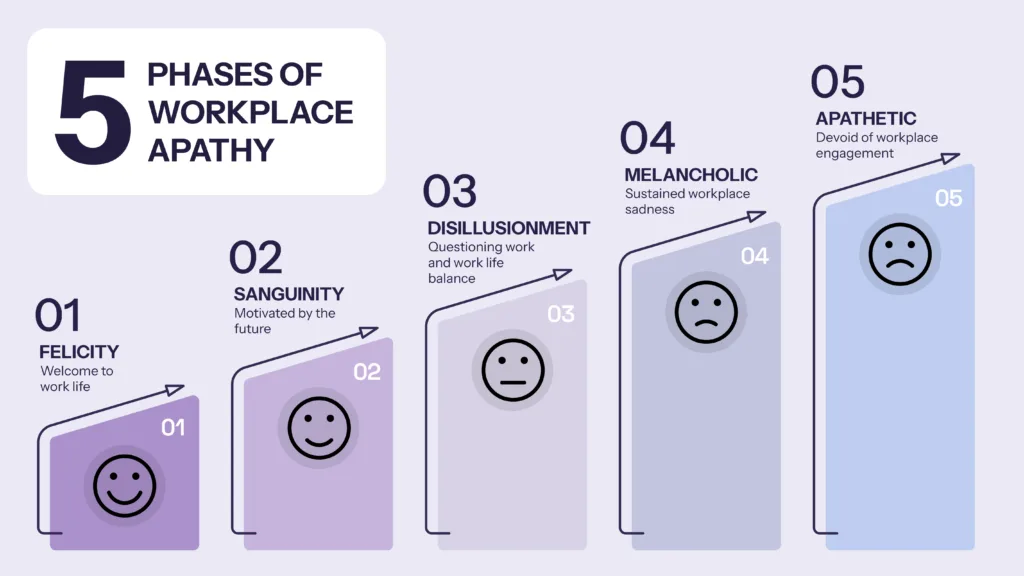
- Felicity: Early career excitement and hopefulness for the future.
- Sanguinity: Some experience with setbacks, but motivated by career growth.
- Disillusionment: Uncertainty about the purpose of work.
- Melancholic: Feelings of sustained disappointment.
- Apathetic: Numbed out after repeated frustrations and work setbacks.
Signs of Workplace Apathy
If you are wondering whether you might be experiencing apathy at work or if this is just a temporary lack of motivation, here are a few potential signs to look out for. Do any of these sound familiar?
- You procrastinate tasks: What should be easy emails are now hard to face. You get 95% of the way through a report, only to stall on the last 5%. In fact, as soon as you sit down at your computer, you would rather be doing anything else.
- Clockwatching: Every second feels like an eternity. As soon as you get in, you are counting down to your lunch break. In the afternoon, the minutes creep by. As a result, you find that you are living for the weekend and wishing the hours away.
- Lack of focus: Even when you do set your mind to work hard on a task, it’s like you have brain fog. It takes far longer than it should to complete your work, even though you know what you need to do and have more than enough time to do it.
- No sense of purpose: Perhaps you were excited when you started your job, but now you feel like you are in a rut. You don’t have any clear career progression, and even if you do, you doubt whether it is worth the effort to try.
- You stop going the extra mile: There isn’t a clear incentive for why you should go above and beyond. So you don’t. Instead, you put in the minimal effort required to make sure you don’t get fired. But it doesn’t feel great, and you miss out on the promotion.
- Things no longer excite you: Stretch opportunities have lost their “zing,” and even new projects seem boring and the same as a million things you have done before.
It’s also worth noting that if you searched for and found your way to this article, this might be a sign that you already feel apathy towards your work.
Take heart, though: the fact that you searched for it is also a sign of self-awareness and that you are motivated to learn how to overcome apathy at work itself.
The Dangers of Apathy at Work
With no intervention, pervasive disengagement can be detrimental to individuals and harm the overarching workplace culture. Here are some worst-case scenarios for why you should never ignore it.
Chronic stress

While more experienced team members might get away with putting in minimal effort and still completing their tasks, others may begin to fall behind. The fallout of this is chronic stress, with workers failing to complete tasks due to motivation issues or burnout and ending up with a stressful backlog.
Manager burnout
One of the core reasons managers are burning out is, interestingly, due to difficulties in motivating their team members. This may be because 57% of them have not received adequate training on how to do so. There is a knock-on effect here. When managers are disengaged (as is the case for 73%), it sets a negative precedent for the rest of their team.
Disconnection from colleagues
It only takes one negative team member to bring down the tone of the entire room. Like enthusiasm, apathy can be contagious. When one person stops contributing to team discussions or pulls back from collaboration, others may fall into the same pattern. That’s not the worst of it, though. This sense of disconnection feeds loneliness, which in turn can increase depressive symptoms.
Career stagnation
When you’re not bringing your A-game, you’re less likely to get noticed for promotions or trusted with growth projects. It could also go the other way, though, where a lack of challenge results in boredom. The numbers confirm this: 71% of workers say that they are experiencing a career plateau due to a lack of employer support for further training opportunities. 34% would even consider leaving over it!
Absenteeism
Particularly in industries like hospitality and retail, employee disengagement and mental health challenges are driving widespread absenteeism. Grab the Advil, employers! This is a warning sign of the employee retention headache. When team members start calling out frequently, or a pattern of no-shows emerges, it’s rarely ever just about the occasional sick day. If you begin to notice it, treat it fast.
How to Overcome Apathy
The good news is, apathy doesn’t need to have a long-term negative effect on you or your workplace. There are ways that you can respond so that you and your team don’t continue to get caught in a vicious cycle.
1. Improve work-life balance
If work is consuming most of your waking hours, then it can feel particularly disheartening if it is also unfulfilling. Combat this by building a foundation of enjoyment and rest in your personal life that can flow into your career.
In a positive spin on quiet quitting, 57% of workers who establish professional boundaries have noticed an improvement in work-life balance. This can help to reduce resentment and create sustainable energy for the work that matters.
2. Get offline!
So much of our lives, both professional and personal, are spent looking at a screen (or even multiple) these days. Unfortunately, too much of this can result in anhedonia, where real life feels flat and unexciting compared to screen life.
Stepping away from the screen to prioritize collaborative in-person activities could give you a much-needed burst of energy. A couple of ideas: take a walking meeting outside or implement a creative brainstorming session.

3. Keep a gratitude journal
Gratitude might seem too simple a solution for apathy. But it totally works. Extensive research has indicated that gratitude practices can reduce depression symptoms by 7%, mitigate anxiety, and improve overall well-being.
Try shifting your focus to what you appreciate about your job, whether that is good relationships with colleagues or a particular client you enjoy working with.
4. Use positive reinforcement
Using positive reinforcement is a powerful way to motivate task completion. This should be more than a “carrot on a stick,” where you are chasing an elusive long-term goal, though. Medical research shows that using short-term rewards is more effective than long-term rewards for increasing internal motivation. Here are some ideas:
- Go for matcha as a team to celebrate project completion.
- Share work wins in your group chat, and thank each other for hard work.
- Switch to a work passion project after spending time on a less inspiring task.
5. Build mentoring relationships
Use mentoring to fight apathy and disconnection in a single stroke. 83% of our (MentorcliQ’s) clients said that being in a mentoring relationship made them want to stay at their company. That is inclusive of both mentors and mentees! Why? Mentees get help in developing their career path, while mentors feel more valued by contributing to meaningful work within the organization.
6. Set relevant goals for growth
When was the last time you had a career conversation with your manager (or better yet, a mentor!)? Setting goals is essential if you want to climb back to the path of fulfilling work.
Yes, it might be hard to picture the future right now. But that is what setting goals is for! Visualize where you want to be in six months or a year and write out a plan of action for how you will get there.
7. Know when it’s time for change
Sometimes, even with all these positive initiatives, the truth is that you might have outgrown your role and are ready for significant changes or new opportunities, whether that means changing departments, retiring, or, in some cases, making a career change. If this is the case, then you might want to consider upskilling to infuse some passion back into your work life.
| Stage of Apathy | Signs | Actions to Overcome Apathy at Work |
|---|---|---|
| Felicity | Early career excitement and hopefulness for the future. | Set clear goals, build strong habits early, seek feedback and mentorship, and take on stretch tasks to sustain momentum. |
| Sanguinity | Some experience with setbacks, but motivated by career growth. | Reframe setbacks as learning, track progress and wins, focus on skill-building, ask for development opportunities, and create a simple growth plan. |
| Disillusionment | Uncertainty about the purpose of work. | Reconnect work to personal values, redefine success, ask for clarity on impact, explore role adjustments, and set meaningful short-term objectives. |
| Melancholic | Feelings of sustained disappointment. | Address root causes of disappointment, seek honest conversations, rebuild confidence through achievable goals, prioritise wellbeing and healthy work life balance, and consider becoming a mentor. |
| Apathetic | Numbed out after repeated disappointments and work setbacks. | Focus on recovery first (rest, boundaries, support), rebuild autonomy with small choices, reintroduce purpose, and explore bigger changes if nothing improves. |
Use Mentoring to Rekindle Your Motivation at Work
There is one main strategy at the core of fighting apathy, and that is connection. In large organizations, though, it can be challenging to make the time for meaningful connections, that is, unless you are intentional about it. MentorcliQ mentoring software can help with this, quickly making matches that work and providing additional resources so that you make the most of them.
We don’t stop at just helping you make matches, only to leave you hanging. We provide continuous support, tailoring the platform to your specific needs and providing training where required. With comprehensive reporting features, you can even see in real-time how the platform is improving engagement.
Book a demo today to see how mentoring can re-spark your workplace engagement.
Modal