
Digitizing Institutional Knowledge So Mentoring Doesn’t Lose Momentum

WHAT’S INSIDE
I want CliQ Updates!
Institutional knowledge helps to keep us all going. Without it, we lose time, make errors, and even drive up costs. And yet, millions of us keep it locked within our heads. What happens to this knowledge when people move on — and what happens to mentoring and its effectiveness?
Let’s explore why the future of mentoring relies on moving digitizing institutional knowledge to get it out of our heads and into accessible, scalable platforms.
Assess Your Risk!
Download our free Succession Risk Assessment tool to determine which employees or roles need a succession plan
Why Mentoring Breaks Down When Knowledge Lives in People’s Heads
Institutional knowledge is information that employees collect and build up over years of service. It can include documented procedures, unwritten rules, contextual nuances, and personal experiences.
Workplace mentoring often thrives on this knowledge, locked within people’s heads and shared with those who want to learn and develop. Mentoring, by its very nature, is the art of passing on knowledge and experience – but it’s often limited.
When people leave companies, change roles, or simply don’t have the time to share knowledge, mentoring falters and loses momentum. Context and lived experience only stay alive for as long as people can share it. As much as 42% of all institutional knowledge is completely unique to an individual!
The Real Cost of Losing Institutional Knowledge
Institutional knowledge, shared through mentoring, helps to keep new employees on the same page and ensures projects continue moving forward efficiently. Without it, people are doomed to learn and relearn.
Losing institutional knowledge can mean:
- People repeating the same mistakes and relearning the same things
- Companies taking longer to ramp up and onboard new employees
- Mentoring becomes inconsistent and even ineffective, with people learning different things with different contexts
- Retirements and resignations posing genuine risks to loss of critical information
For example, imagine a long-serving employee leaves or retires from a marketing firm. They never documented or “saved” their experiences or understandings of processes, and will no longer be around to support copywriters, designers, or sales teams on effective strategies. It’s part of why there continues to be a push towards digitizing important documents.
Unless the remaining workforce has effectively documented the leavers’ institutional knowledge for them, their experiences are gone forever. It’s a huge loss to companies at large, with 63% of firms already claiming high churn negatively affecting internal culture. With no succession plan, that valuable institutional knowledge that just…disappears.
Why Traditional Mentoring Alone No Longer Scales
One-to-one mentoring, while highly effective, is not a scalable model for growing teams — especially for those that are split across different time zones and continents. After all, around 92% of teams are now considered more “hybrid” than ever since the height of the COVID-19 pandemic.
While remote and hybrid work have brought improvements to corporate communication, they are not ideal for sharing informal knowledge. In some cases, mentors may spend days out of their schedule sharing the same information over and over again, repeating the basics to different employees, rather than offering intensive coaching.
And, the larger the company, the greater the chance of turnover. With companies growing to be thousands of employees in size, spread across thousands of miles, institutional knowledge can leave a firm at any time without warning.
There needs to be a system, therefore, to support mentoring on the remote world stage so that institutional knowledge can be protected, and so individuals (and companies) continue to benefit from mentoring.
Digitization is increasingly seen as a great option for retaining this knowledge, building a support system for mentors and mentees (though never replacing individual support outright).
What Digitizing Institutional Knowledge Actually Means
Digitization is all about saving information in a digital format so it can be accessed easily time and again. Digitized institutional knowledge could therefore be shared as part of onboarding presentations, during self-coaching sessions, or even as part of directed mentoring, without the need to rely on individuals’ internalized experiences.
Digitization captures those experiences, along with context and personal judgments, so that everyone can access them and use them in their everyday work.
Common methods for capturing this knowledge might include drawing up playbooks and templates, tailored to showing employees how to make certain decisions, step by step. Perhaps simpler, mentors could draft up FAQs or submit common concerns to online knowledge bases, so people always have access to knowledge.
One of the best ways to digitize institutional knowledge is to explain the why as well as the how. That way, new users can easily understand the context and motivations behind decisions beyond the end results.
For example, what processes for selling certain products work best in practice?
Over time, what are some points that can easily be modified or skipped altogether to keep things efficient? Process documentation, in general, arguably drives growth, too.
Did you know…
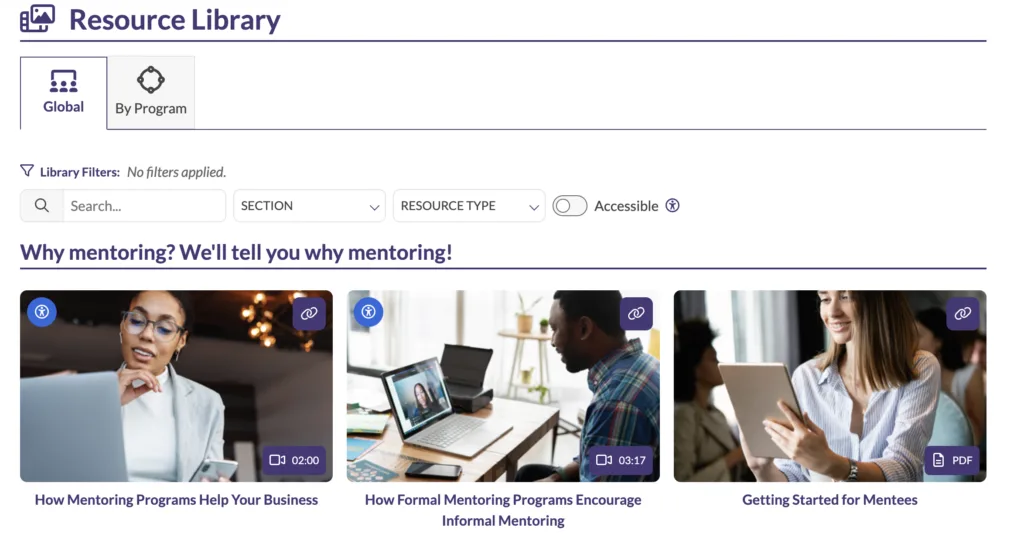
MentorcliQ has a fully-powered resource library that allows admins to upload different different types of digital media, including videos and PDFs (including ones edited using DocFly).
How Digitized Knowledge Keeps Mentoring Moving Forward
With digitized, backed-up knowledge, all mentees have the same starting point, making for a more uniform, consistent learning and development process.
That means mentors can then focus their efforts on helping mentees grow individually, rather than repeating the how and the why of processes over and over again.
What’s more, base institutional knowledge stays consistent across different teams, even those split across different countries. Digitizing institutional knowledge in this way, by creating a baseline for mentees to work from, means that mentoring can continue rolling forward even when people move on and positions change.
How Organizations Can Start Without Overcomplicating It
It’s easy to overcomplicate digitization. However, even the biggest of companies can start making mentoring more streamlined by focusing on roles with high knowledge concentration first. For example, programming and coding roles where mentees might be working on very different projects from one day to the next, and may need an adaptive skillset.
The key idea is also to capture the most common answers mentees ask. Start small, too, on a single team or function, and ensure that particular area is completely accounted for.
Above all, do more than just “save” knowledge. Make sure it’s accessible, easy to search, and regularly updated. Give mentees the ability to self-train with digitized knowledge, and it’ll stay evergreen.
Modal