
Upskilling Isn’t Enough: Employees Need Somewhere to Put Their Job Skills to Work
WHAT’S INSIDE
I want CliQ Updates!
Before employees even enroll in a training course, there’s a question worth asking: Are they learning the skills that actually matter? If your organization doesn’t have a clear picture of its existing capabilities or the gaps it needs to close, development can feel rather generic. Employees may struggle to see how a course relates to their work or where it could take them next.
Even when the training is relevant, there’s another hurdle. Your employees complete a course, learn new skills, and add another certification to their resumes. Great! But what happens when they return to their everyday tasks? Without opportunities to put those skills into practice, or someone to help them work through challenges, learning can stall.
For Human Resources (HR), talent, and Learning and Development (L&D) leaders, these challenges are becoming more urgent. Employers expect 39% of workers’ core skills to change by 2030, according to the World Economic Forum’s Future of Jobs Report 2025. The future of skills development depends on getting both stages right: identifying the skills that matter and creating opportunities to put them to work.
Why Is Upskilling Not Enough?
Technological advances (hello, AI) and changing business priorities have reshaped what are considered the most essential skills for organizations. Employees must learn new tools, adapt to different ways of working, and develop capabilities that help them contribute as their roles evolve.
That starts with understanding the capabilities already within your workforce. Skills intelligence helps organizations map existing strengths, identify meaningful gaps, and connect employee capabilities to changing business needs.
That clarity, unfortunately, is often missing, even when learning opportunities are available. WorldatWork’s 2026 State of Rewards reports that 84% of organizations offer formal learning opportunities and 78% provide coaching and mentoring. Yet only about half of employees are satisfied with their career development opportunities. Access to development matters, but employees also need to understand how it connects to their work and future growth.
With skills intelligence platform like SkillsCliQ powered by Neobrain, HR and L&D teams can turn those insights into clearer development priorities, so employees can see which skills to build and why they matter for their roles and career paths.
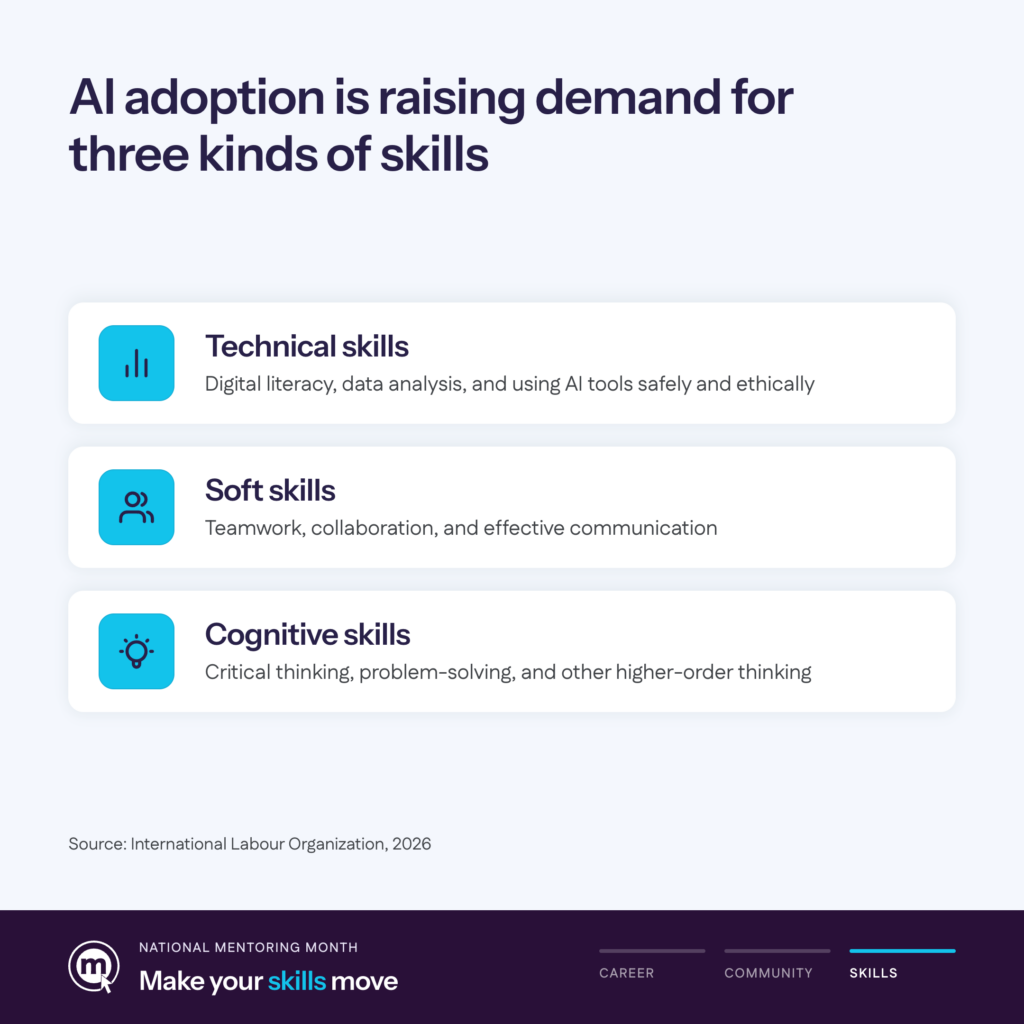
The International Labour Organization’s 2026 research on skills in the age of AI found that AI adoption is increasing demand for:
- Technical skills: Digital literacy, data analysis, and the ability to use AI tools safely and ethically.
- Soft skills: Interpersonal skills that support teamwork, collaboration, and effective communication.
- Cognitive skills: Higher-order mental abilities, including critical thinking skills and problem-solving.
The future isn’t simply about knowing how to use the newest tool. It’s about knowing how to think, adapt, collaborate, and make decisions alongside new technology. This can make skills development more complicated.
An employee may learn how to use an AI tool, but how should they use it in their specific role? What should they do when the output isn’t quite right? And how can they apply it without losing human judgment? Those questions aren’t always answered in a training module. Sometimes they come from another person.
How Mentoring Makes Skill Development Real
Knowing which skills to develop is only the first step. Once those priorities are clear, employees need guidance and opportunities to use what they’ve learned. Training courses remain valuable, but they can’t always account for the challenges employees encounter when applying what they’ve learned to real situations.
That’s where mentoring comes in.
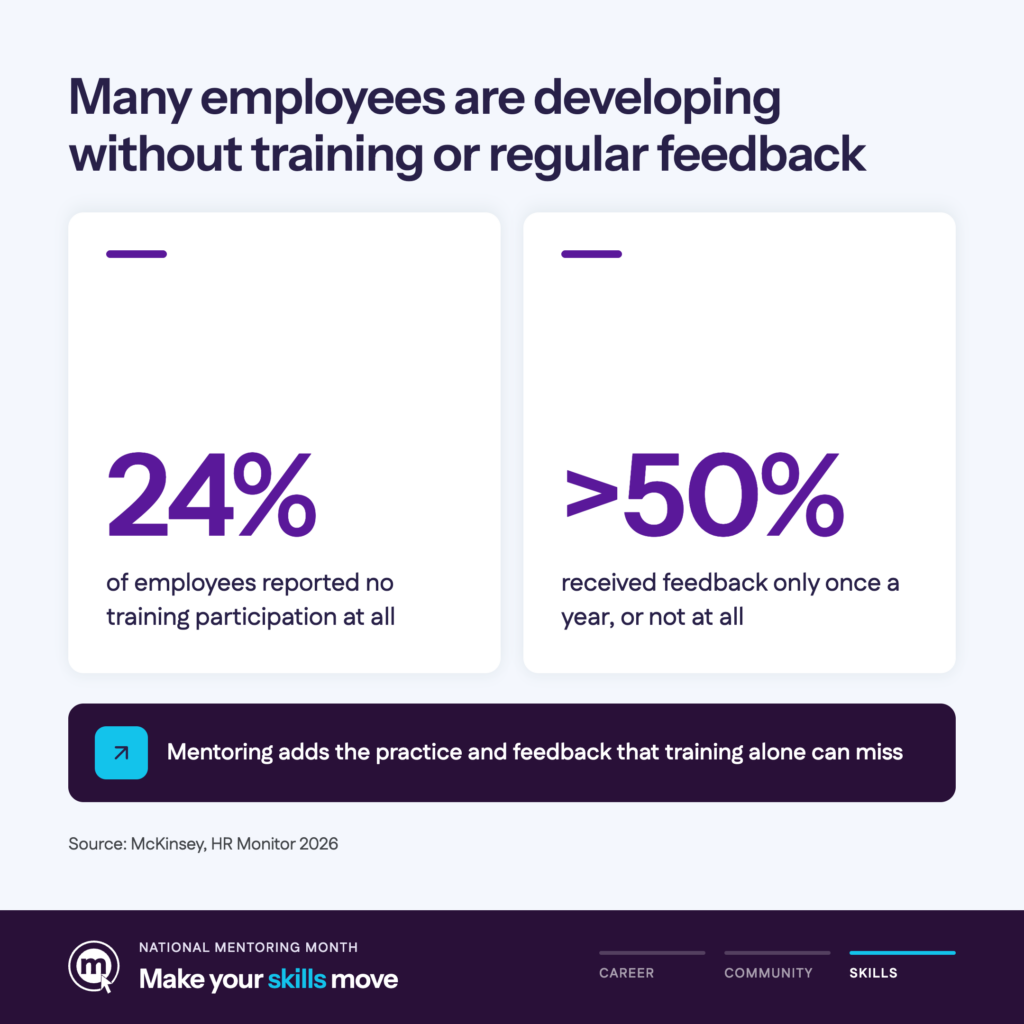
According to McKinsey’s 2026 HR Monitor, 24% of employees reported no training participation at all, while more than half said they received feedback only once a year or not at all. Workplace mentoring can offer another source of practical support and feedback as employees develop their skills.
Mentors bring practical knowledge gained through real-life work. They understand the challenges, decisions, and unexpected problems that don’t always appear in a training course. A good mentor will be able to:
Put new skills into context.
A mentor can help mentees understand how a new skill applies to their specific role and responsibilities. For example, an employee might learn analytical skills through a data training program. A mentor who regularly works with data can explain how to interpret results, identify useful insights, and present findings to decision-makers.
Provide opportunities to practice.
Your team builds their skills by putting them to use. Mentoring can help them identify manageable opportunities to do that. Someone developing leadership qualities might practice facilitating a meeting or leading part of a group project. They can then talk through what happened with their mentor and decide what to try differently next time. These smaller opportunities provide experience before employees take on greater responsibilities.
Offer relevant feedback.
Feedback helps employees understand what they’re doing well and what they could improve. Rather than waiting for their next performance review, your team members can use mentoring conversations to discuss a recent challenge, reflect on the outcome, and consider a different approach for next time.
A mentor might help someone recognize where their communication was effective, explore alternative ways to solve problems, or encourage them to consider a fresh perspective. That ongoing feedback can be especially valuable when employees are still developing confidence in a key skill.
Encourage mentees to take initiative.
Sometimes, employees have the knowledge they need but hesitate to use it. A mentor can encourage them to contribute ideas, volunteer for a new task, or take greater ownership of their work. For employees developing interpersonal skills, leadership skills, or other capabilities that improve through experience, that encouragement can help turn intention into action.
How to Create More Opportunities for Skill Application
HR, talent, and L&D leaders should connect training, mentoring, and everyday responsibilities in one ecosystem rather than treating them as separate development activities. The following steps can help you make skills development more practical across your organization.
1. Identify priority skills and connect learning goals to workplace responsibilities.
Start by assessing skills gaps across roles and teams.
Which capabilities does your organization need?
Which ones do employees already have?
Where would development make the biggest difference?
A clearer view of those gaps helps you explain why a development goal matters to an employee’s work or next career move.
Then, make it clear what employees should be able to do once they complete their training. Rather than setting a broad objective such as improving communication or developing hard skills, focus on specific activities where those skills can be demonstrated.
2. Match mentees with mentors who have relevant expertise.
The most effective mentor for a particular development goal isn’t necessarily the most senior person in the organization. It’s someone with the experience and knowledge to help an employee develop the skills they’re working toward.
Someone developing leadership skills might benefit from a colleague who regularly manages teams, while an employee improving their writing or communication skills could learn from someone who presents complex information to different audiences.
MentorcliQ’s Smart Match™ makes finding the right mentor easier! Its configurable matching algorithm considers factors such as skills, development goals, experience, and personal preferences to create relevant mentor-mentee matches.
3. Create opportunities to develop leadership skills.
Leadership skills are becoming indispensable in an AI-driven workplace. Why? If you imagine that AI is like a smart intern, then it follows that someone has got to lead it in the direction it should go. Developing leadership skills doesn’t necessarily mean preparing employees to manage a team. It’s about building their ability to adapt, take initiative, and communicate expertise. A skills-based organizational model can create more opportunities to do that by connecting employees with projects and mentoring based on their capabilities, not just their job titles.
Organizations can create opportunities to practice these skills through:
- Reverse mentoring: Employees share their knowledge of new tools, technologies, or emerging workplace practices with senior colleagues.
- Peer mentoring: Supporting co-workers as they develop new skills helps employees strengthen active listening, problem-solving, and interpersonal skills.
- Group projects: Taking responsibility for coordinating tasks, presenting findings to stakeholders, or leading a project that requires strong collaboration.
- Cross-functional initiatives: Inter-department working helps employees adapt to unfamiliar situations, express ideas creatively, and learn to influence people with different perspectives.
Top tip: During busy periods, keep development opportunities manageable so employees have the time and support to build their skills without adding unnecessary pressure.
4. Encourage soft skills through community.
One-to-one mentoring isn’t the only way employees can learn from others. Peer mentoring, group mentoring, and employee resource groups (ERGs) also provide opportunities to share knowledge and develop skills collaboratively. To take a modern example, employees learning to use new AI tools may benefit from a community where colleagues discuss practical applications, share successful approaches, and help one another solve problems.
With technology solutions such as CommunityCliQ, organizations can support communities of practice where employees exchange expertise and continue learning beyond formal training. These opportunities can also strengthen workplace culture by encouraging knowledge sharing and collaboration across teams.
5. Make feedback part of development.
The opportunity to practice a skill is important, but employees also need to understand how they’re progressing. Encourage mentors and mentees to discuss recent experiences during their regular meetings. Rather than focusing only on broad career goals, these conversations can explore specific situations where employees have applied new skills.
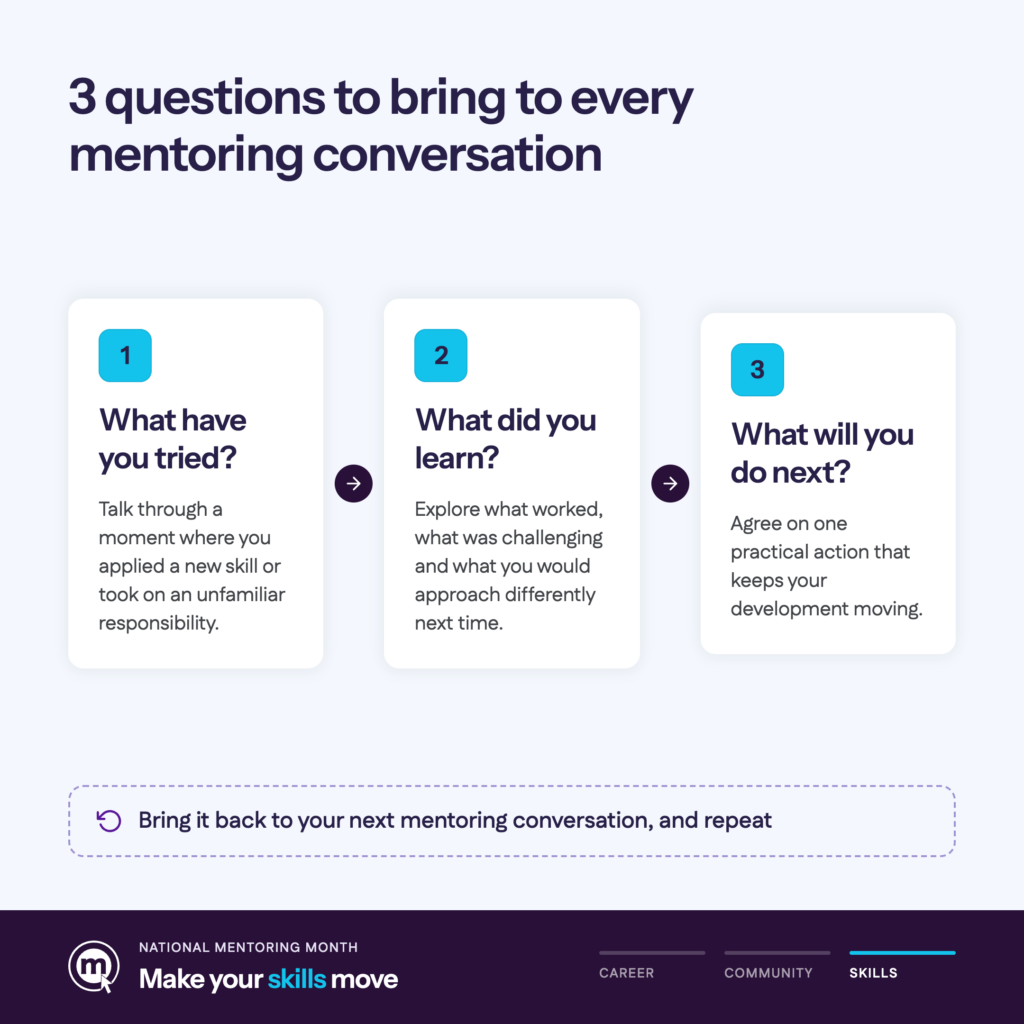
Three questions can provide a useful structure:
- What have you tried? Discuss an opportunity where the employee applied a new skill or took on an unfamiliar responsibility.
- What did you learn? Explore what worked, what was challenging, and what the employee might approach differently next time.
- What will you do next? Agree on a practical action that will help the employee continue developing.
The Future of Upskilling Is Human
Technology will continue to change the skills employees need. Organizations will continue to invest in learning platforms, courses, certifications, and development programs. All of that matters. But the strongest development plans start with a clear understanding of which skills matter, and they don’t stop when a course ends. Employees build capability when they have opportunities to practice, experiment, ask questions, and learn from people who’ve been there before.
Eventually, they become the person someone else turns to for help. That’s why the future of skills development isn’t simply about giving employees more things to learn. It’s about creating more opportunities to learn, connect, practice, apply, and grow.
Make Your Skills Move With MentorcliQ
As skills requirements continue to change, organizations need more than a list of courses. They need to understand the skills their people have, identify what’s missing, and help employees use new capabilities in meaningful ways.
This National Mentoring Month, make your move toward development that has both a clear direction and a practical next step.
Ready to make mentoring part of your skills development strategy? Book a demo and see how MentorcliQ can help your employees learn, develop, and grow.
Modal