
What Is Skills Taxonomy, and How Can It Benefit Your Organization?

WHAT’S INSIDE
I want CliQ Updates!
Have you ever opened a job description or resume, only to find a list of fluffy buzzwords? Sure, it sounds nice that Sue is a ‘good communicator,’ but what does that actually mean? It could be anything from presentation skills to client diplomacy to just liking a gab at the water cooler!
When people don’t speak the same ‘skills language,’ it’s hard for them to understand each other, and that is where a skills taxonomy comes in. Let’s unpack exactly what it is, some stellar benefits for your organization, and how to implement a taxonomy that your employees actually use and love.
What Is a Skills Taxonomy, Anyway?
A skills taxonomy is, in essence, a language. It gives everyone in your organization an agreed way to name, describe, and organize skills. No more wondering what the difference is (if any) between ‘copyediting’ and ‘proofreading.’ A skills taxonomy classifies workforce skills in a kind of catalogue that defines exactly what each term means and what it looks like in practice.
Most skills taxonomies use a hierarchical structure. Broad skills categories branch into more specific capabilities, complete with clear descriptions and proficiency levels. For example, project management might include risk management, resource allocation, financial modeling, and stakeholder communication.
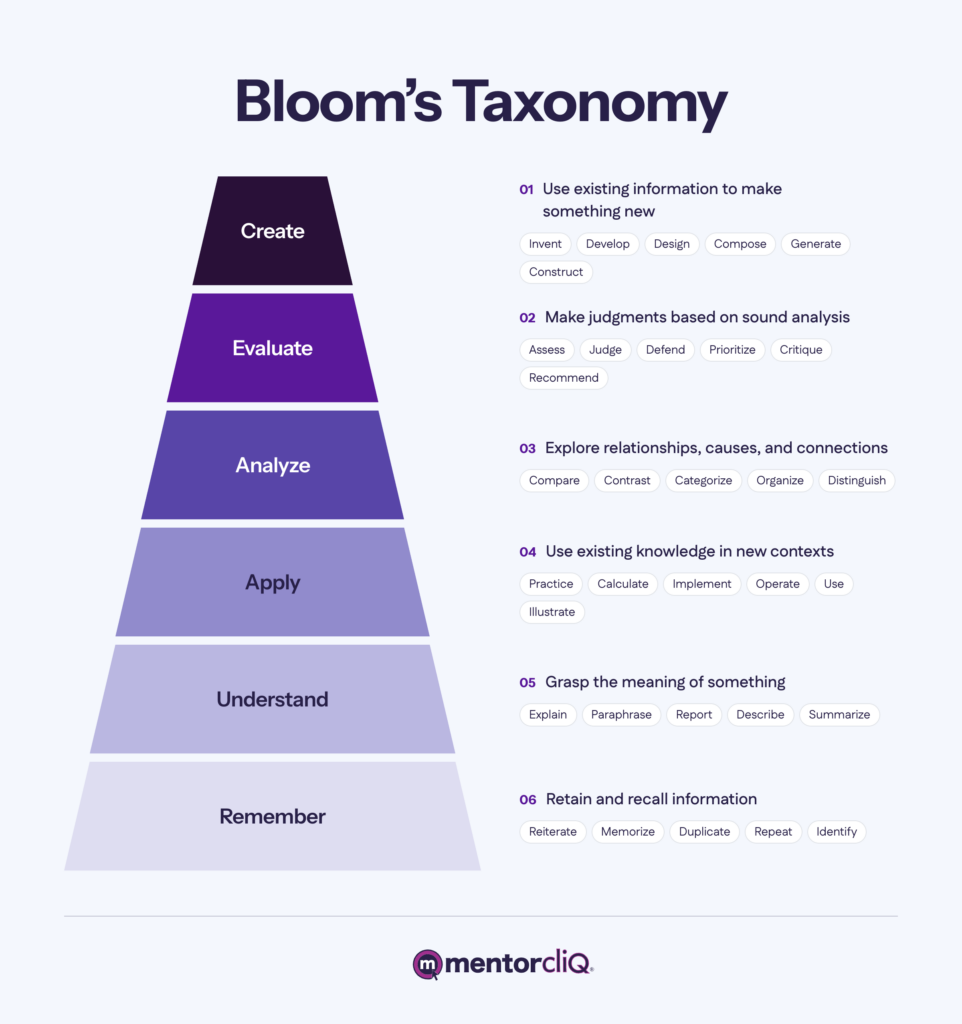
One of the earliest known versions is Bloom’s taxonomy of 1956, which educators used to foster emerging skills in their students. It’s split into six key areas, according to complexity.
Skills taxonomy vs. skills ontology
While a skills taxonomy organizes skills into a clear hierarchy, a skills ontology goes one step further by mapping how different skills, roles, and tasks relate to one another. To give an example, a taxonomy would be responsible for filing data analysis under technical skills; an ontology would connect it to related skills such as financial modeling and machine learning, along with the roles that require them.
The Problem With Inadequate Skills Language
On the surface, inconsistent skills language might seem like harmless corporate word salad. In practice, it makes it much harder to see what your people can do, identify what is missing, and decide which capabilities to develop next. This is particularly important given that 63% of employers identify skills gaps as a major barrier to business transformation. This is where it can get complicated:
The same skill can have several names.
You need a new team member who works well with others, so sit down to draft a job description. Teamwork sounds too obvious, so you opt for collaboration. Or, if you’re feeling fancy, something like group synergy.
At the end of the day, all these terms mean the same thing: someone who communicates in a clear and timely way, supports their colleagues, and understands how different roles work together toward a shared goal. If only you had one word that everyone understood!
Job titles only tell part of the story.
Only 32% of business leaders strongly believe their organization currently has the skills it needs for the future. But what if these sought-after skills are hiding right under CEOs’ noses? A job title might tell you where someone sits on the org chart, but it rarely captures everything they can do. Your unassuming project coordinator could be a data analysis whiz or a natural mentor, but unless you look beyond their title, those valuable skills may remain hidden.
Your skills landscape is shifting.
Skills demand in modern industries is shifting at break-neck speed, with new terminology being added all the time. Vibe coding, prompt engineering, and human-in-the-loop validation are just a few of the new skills popping up in job descriptions around the world. If your organization doesn’t have a way to categorize these competencies, things could get real confusing, real fast.
Benefits of Skills Taxonomy
A good skills taxonomy takes more than copying a list of competencies into a spreadsheet and calling it a day. It should be like a skills library, neatly categorized and easy to browse. Here are some of the benefits of getting it right:
Create a shared language
33% of organizations say connecting and consolidating data across systems is a barrier to adopting a skills-based strategy. A skills taxonomy gives employees, department heads, and HR professionals a shared language for discussing talent. Instead of one team asking for “data interpretation” while another searches for “data analysis,” everyone works from consistent skill names and descriptions.
See the skills you already have
Sure, job titles are useful (we’re not saying to get rid of them!), but they rarely reveal every capability hiding within your workforce. For example, your marketing manager might have project management experience from a previous role, while someone in finance could be the go-to person for mentoring new employees on how things really work around here. Collected skills data makes this clearer.
Spot skill gaps early on
Nobody wants to discover a critical skill gap halfway through a major project. By comparing existing skills with those required for future roles and strategic goals, your organization can identify missing capabilities before they become full-blown problems. This can then support you to either bring in fresh talent or upskill the staff you already have.
Build mentoring around real skills needs
According to Workday, 46% of businesses use mentoring and coaching programs to address skills gaps, making it the second-most common workforce development behind adopting AI and other technologies (at 49%). With consistent skills data, you can build programs around genuine workforce needs and make more relevant mentor-mentee matches.
Increase employee engagement
Don’t make career progression a guessing game for employees. With clear skills descriptions, your people can see the skills required for their current role, compare them with the requirements of a future position, and build development plans around the gaps. Career mentoring then brings that plan to life by connecting employees with people who can share relevant experience and help them develop their career.
How to Build a Skills Taxonomy
Ready to bring some order to the skills chaos? It might seem overwhelming, but you don’t need to do everything all at once. Start with a clear purpose, involve the people who use these skills every day, and take it one step at a time from there.
1. Start with the problem
Decide what your taxonomy will primarily support: it could be workforce planning, recruitment, mentoring, career pathing, learning, or another talent management priority altogether. The main thing is to talk to your people and see exactly where language is ambiguous so that you know where to focus your efforts.
2. Gather skills intelligence
From job postings and employee profiles through to mentoring programs and competency frameworks, review the language your people currently use. Ask employees and managers what these formal records might have missed, either where there are gaps that aren’t yet filled or skills that exist but aren’t documented.
3. Organize into useful categories
Create a logical hierarchy covering technical skills, soft skills, core skills, role-specific capabilities, and emerging skills. Keep it detailed enough to be useful, yet simple enough to navigate. Note that this work is becoming standard practice: 55% of organizations have started transitioning toward a skills-based model, with another 23% planning to begin within 12 months.
4. Define skills and proficiency
Give every skill a clear name, practical description, and observable proficiency levels. To keep it simple, terms like ‘beginner’ and ‘advanced’ should mean the same thing across different teams, rather than whatever an individual manager or HR leader decides.
5. Connect skills with career paths
Only one-third of companies create career paths that include the required skills and recommended learning for employees. Your taxonomy can provide that missing structure by mapping individual skills to relevant roles, projects, learning opportunities, and adjacent capabilities. This helps employees understand what they need for career progression and gives leaders a clearer picture of how talent can move across the organization.
6. Put the taxonomy to work with mentoring software
The 2025 LinkedIn Workplace Learning report found that 36% of non-career development champion organizations use internal data and tools to identify skills gaps. Among organizations with the most mature career development programs, that figure rises to 49%. One popular solution? Mentoring software!
In fact, mentoring software solutions from companies like MentorcliQ can:
- Capture the skills employees want to learn or share
- Match mentors and mentees around relevant capabilities
- Turn identified gaps into mentoring goals
- Create focused development plans
- Track progress and participant feedback
7. Review and update as skills evolve
Finally, be sure to apply the same agreed-upon language across every department, HR or otherwise. Then use employee feedback, mentoring activity, labor-market insights, and any changing business needs to keep the taxonomy current. Machine learning can help analyze the data, but HR professionals and subject-matter experts should still check that its suggestions make sense.
Partner with MentorcliQ to Strengthen Employee Skills
A skills taxonomy gives you the map. The next step is helping people get where they want—and where your organization needs them—to go. That means connecting employees with colleagues who already have the skills, experience, and hard-earned lessons they need.
One great tool is previously mentioned MentorcliQ mentoring software, which helps turn your skills data into structured employee development. Our Smart Match™ feature uses configurable criteria, employee preferences, and personality markers to match mentees with mentors who have relevant knowledge and experience, without your HR team spending hours pairing people in a spreadsheet. Mentoring app surveys then track meeting activity, goal progression, and match satisfaction, helping you see whether mentoring relationships are moving those carefully defined skills forward.
Let’s agree that your taxonomy should become yet another document that gathers dust. Book a demo with MentorcliQ to see how mentoring can turn it into real connections and stronger skills across your entire organization.
Modal