
The Artemis II Mission Has Launched the Next Aerospace Talent Race
WHAT’S INSIDE
I want CliQ Updates!
When Artemis II launched, it didn’t just mark humanity’s return to the Moon. It set in motion the beginning of something else entirely:
The next great space race.
But this time, the competition involves more than two large governments vying to prove their engineering prowess amid a slow-burning cold war. This space race will involve thousands of companies, all trying to stake a claim and secure massive sums of money from governments and megacorporations as they expand mankind’s footprint into deep space.
That’s more than just an engineering problem. It’s a talent problem.
With aerospace engineering talent already in great demand, the talent market is about to get worse.
Much, much worse.
Companies that can’t protect their engineering talent right now risk losing the space race before it even begins. Investing in solutions designed to protect critical human infrastructure is essential, and hidden within the story of the Artemis II mission are more than half a dozen companies already ahead of the game.
They’re using MentorcliQ’s mentoring platform to provide structured engagement, skill development, and culture-building for their engineering talent, helping them not only retain their best engineers amid the growing space race but also steal the best talent from competitors.

From Moon Missions to Market Competition
The Artemis II mission represents one of the most complex engineering efforts in modern history. Being the first crewed mission in over 50 years to send humans to the moon was a milestone by itself. But the mission also brought together over 2,700 suppliers, engineering firms, labs, and other organizations responsible for everything from propulsion and flight systems to radiation research and deep space infrastructure.
Behind the scenes, some of the world’s most advanced organizations are already playing critical roles, and importantly, those companies are using MentorcliQ to develop and retain their talent:
- Draper:
- Built guidance, navigation, and control (GN&C) software for mission-critical flight operations for Artemis II
- MentorcliQ customer for over 3 years
- Over 6,500 hours of mentoring logged
- 41% improvement in retention, saving over $2.3 million at a 45x ROI
- Pacific Northwest National Laboratory:
- Leading research on radiation and life sciences in space essential for current and future Artemis missions
- MentorcliQ customer for over 4 years
- 7,500+ hours of mentoring logged
- Over $5.2 million in retention savings with a 31x ROI
- Howmet Aerospace:
- Delivered precision casting and forging for launch systems for the Artemis II mission
- MentorcliQ customer for over 3 years
- 2,000+ hours of mentoring logged
- Strong positive feedback from participants. As noted by one participant: “My mentor has been amazing. He is invested in helping me grow by providing both guidance and his personal background.”
- Oak Ridge National Laboratory:
- Advancing nuclear materials and isotopes that will power future missions
- MentorcliQ customer for over 2 years
- 3,500 + hours of mentoring logged
- 4.9/5 mentee relationship satisfaction rating
Beyond those organizations, several other organizations using MentorcliQ played critical roles in the Artemis II mission and the ongoing Artemis program:
- An organization designing and integrating the core service modules that power crewed spacecraft
- A company developing next-generation sensors, environmental systems, and space suits
- A firm with specialists building ignition and propulsion systems capable of delivering millions of pounds of thrust
- A government agency orchestrating the whole project and coordinating one of the most ambitious missions in decades
Artemis is not just a mission. It’s an ecosystem of public and private organizations, all working to achieve the same goal, but all competing to attract and retain a very limited talent pool.

Companies Protecting and Attracting Talent Will Win the Next Space Race
Every one of these contributions depends on one thing:
Highly specialized engineering talent. And that talent is becoming increasingly scarce.
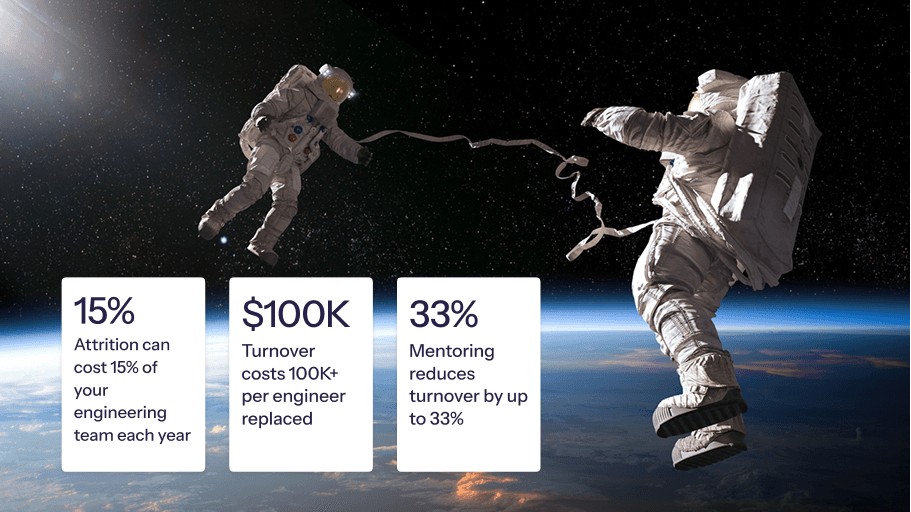
- Aerospace attrition has risen to 15% and is likely to increase in the years to come (according to McKinsey & Company)
- Time-to-fill for technical roles is increasing and sits at over 60 days for companies in Aerospace (according to the Josh Bersin Company)
- Engineers switching jobs are commanding higher salaries, and young engineers are around twice as likely as experienced engineers to consider switching jobs (according to McKinsey & Company)
- Open roles are costing organizations tens of thousands per month in lost productivity (according to the American Society of Mechanical Engineers)
The takeaway is clear: The organizations competing for contracts, grants, and innovation leadership in this new space race are also competing for the same limited pool of talent.
Your Place in the Talent Race Will Decide Your Place in the Space Race
In the past, success in aerospace came down to funding, infrastructure, and technical capability. Those are still true. But now, the market for competition and the slow growth in new engineering talent has created an exceptional problem for aerospace talent pools.
The real differentiator for companies operating in aerospace is this: Can you attract, develop, and retain the engineers who make all of it possible?
Here’s the current reality for aerospace leaders:
- Engineers now have more choices than ever for who to work for
- They can move between organizations quickly and profitably, averaging a 5% salary increase with each move (and likely more in the coming years)
- And they are increasingly choosing employers based on:
The companies that win are those laying strong groundwork for human infrastructure through better employee development and a day-to-day work experience.
How Are Leading Aerospace Companies Handling Employee Engagement and Development Differently?
There are several key similarities to the focus areas for companies contributing to the Artemis II mission that are using structured mentoring to support employees:
- Mentorship and knowledge transfer
- Early-career development
- Leadership pipelines
- Cross-functional collaboration
- Long-term engagement strategies
These companies recognize that they can’t compete on contracts if they aren’t first competitive in the increasingly talent-constrained market for engineers.
That kind of competition isn’t won with ad-hoc, manual, and poorly-measured programs. It’s won with dedicated infrastructure.
The High Cost of Falling Behind the Aerospace Talent Race
Here are the numbers and facts you need to sear into your brain as you argue internally for a better approach to people development and retention:
- ~15% of your engineering workforce may leave this year
- For a 100-person engineering team, that’s 15 departures annually.
- Each one comes with:
- Recruiting costs
- Salary increases to replace them
- Productivity loss while roles sit unfilled
When you model that out, your costs quickly reach millions of dollars per year.
The cost quickly reaches into the millions per year. Organizations that implement structured mentoring programs see ~33% reductions in turnover, with many enjoying 50% or more reduction in turnover through a targeted, structured approach to development and engagement.
Calculate What This Means for Your Organization
If you want to understand what this talent race actually costs your team (and what reducing turnover could mean financially) you can model it directly:
In just a few inputs, you’ll see:
- The true cost of attrition on your team
- The financial impact of improving retention
- How those savings compare to your engineering salaries
Organizations Leveraging Software in the Aerospace Talent Race Are the Ones That Will Attract + Retain The Right People
As Artemis II sparks renewed investment and competition across aerospace:
- More high-dollar contracts will be awarded
- More innovation will be required
- More talent will be needed
Not everyone will be able to keep up, even as the market expands to include more companies seeking to offer services and place their mark on the moon and beyond.
Will your organization compete for talent with mentoring software… or lose it to those who already are?
Modal