
How Wikipedia’s New Editor Mentoring Offers Inspiration for Enterprise-Level New Hire Mentoring Programs

WHAT’S INSIDE
I want CliQ Updates!
Wikipedia isn’t known for being flashy, so imagine my surprise when I recently created an account and discovered a hidden gem: it assigns all new users an editing mentor. Wikipedia has a notoriously convoluted editing and content approval process, so launching what amounts to a user-generated content platform’s new-hire onboarding program is a smart move.
It also provides an excellent template for profit-generating businesses to follow, with some important differences needed in the implementation and structure of the program. After all, Wikipedia is running a free, slim program where the stakes are rather low. For a business, new hire mentoring is exceptionally high-stakes, and getting it wrong could mean the continuation of the kind of high turnover rates and low productivity rates that often hound companies until new hires get acclimated to their roles.
There’s a clear charge here for HR leaders:
- New-hire retention has always been a challenge, with industry benchmarks indicating that 15-20% of new hires leave within the first 12 months.
- SHRM found that 69% of new hires stay longer if they’re given a good onboarding experience (new hire mentoring easily satisfies this)
- New hires typically take 6-12 months to reach 100% productivity, but Brandon Hall Group found that effective and structured new learning experiences boost time-to-productivity by 103%.
The takeaway is what we’ll cover here:
- Wikipedia is offering for free to its users what businesses should be offering to its employees, but at a smaller, less structured scale
- Businesses can replicate this concept at scale with more structure to generate real and measurable bottom-line impacts of employee retention and productivity
The mechanics are different, but the problem Wikipedia was solving is the same one every HR leader faces when a new hire walks in on day one: how do you get someone from “just arrived” to “genuinely contributing” before they decide it isn’t worth the effort?
Closing the Large New Hire Productivity Gap
Common knowledge (and experience) states that new hires aren’t productive on day one. It doesn’t matter whether they’re 20-year veterans starting at a new company or college-grad greenhorns. Starting a new job with a new employer always comes with its own challenges.
Heck, even boomeranging back to the previous employer requires a bit of onboarding. That was my experience after leaving MentorcliQ for a year and returning as a boomerang employee during what we jokingly call around here my “sabbatical.”
Here’s a helpful breakdown of the type of hurdles new hires (both experienced and entry-level) face when starting a new role.
New hire onboarding challenges: experienced vs. entry-level employees
Onboarding challenges don’t disappear with experience. Whether someone is entering the workforce for the first time or joining a new company after 20 years, they face a distinct set of hurdles — many of which overlap. The table below breaks down which challenges are universal and which are specific to each group.
| Challenge | Experienced Hire | Entry-Level Hire |
|---|---|---|
| Shared Challenges | ||
| Learning company culture and unwritten norms | ✓ | ✓ |
| Building relationships and trust from scratch | ✓ | ✓ |
| Understanding internal processes and workflows | ✓ | ✓ |
| Navigating organizational hierarchy and politics | ✓ | ✓ |
| Learning company-specific tools and systems | ✓ | ✓ |
| Understanding performance expectations | ✓ | ✓ |
| Figuring out who makes decisions and how | ✓ | ✓ |
| Experienced Hire Challenges | ||
| Unlearning habits from a previous employer | ✓ | — |
| Managing the gap between reputation and current impact | ✓ | — |
| Resisting the urge to “do it the way we did it before” | ✓ | — |
| Proving credibility without relying on past reputation | ✓ | — |
| Entry-Level Hire Challenges | ||
| Learning professional workplace norms for the first time | — | ✓ |
| Developing foundational job skills on the job | — | ✓ |
| Navigating authority and managing up | — | ✓ |
| Understanding career path options and advancement | — | ✓ |
New hire productivity gaps exist for two reasons:
- New hires may have skills gaps required for the role that can only be closed with upskilling into institutional knowledge
- New hires may lack an understanding of organizational structure and norms that significantly slow down productivity goals, even with the requisite skills
This is why onboarding programs exist in the first place. New hires aren’t productive on day one. Everyone knows this. But the size of the gap is worth stating plainly.
New hire productivity data
According to BambooHR research, new hires form lasting impressions of their company within the first 44 days. Still, that window closes long before most employees reach full productivity. Retention and productivity numbers eventually improve for employees who stay, but structured support accelerates this improvement significantly.
New hires with effective onboarding programs reach full competence in 4–6 months rather than 8–12. And yes, you can quantify that competence and retention. There are 5 figures you need:
- Recruitment cost per role
- Turnover/replacement cost per role
- Annual financial contribution of the role
- Average productivity during the ramp period
- First-year turnover rate for this role
You can use the bellow calculator below to calculate the cost of running new hire mentoring programs or other engagement programs that reduce the time-to-productivity and increase retention.
New Hire Onboarding ROI Calculator
Enter your numbers to see exactly what ineffective onboarding costs you — and what you save when new hires get up to speed faster.
No commitment. Talk to a mentoring program specialist.
This calculator provides estimates based on your inputs. Actual results will vary by organization, role type, and program design. Sources: SHRM cost-per-hire benchmarking; SHRM onboarding research; Gallup new hire productivity data.
A commonly stated figure you may have already seen is that nearly 30% of new hires leave within their first 90 days. Twenty percent quit before day 45. The original source of that data is a bit dubious, but we’ll let it stand since it’s the one everyone’s going to reference.
With that as the baseline, these aren’t underperformers who were bad hires. Many are capable people who didn’t get the connection, clarity, or guidance they needed to feel like they belonged and knew where they were headed.
Wikipedia’s mentoring program was designed to solve a version of this problem. It’s worth understanding how it does that, and where the parallels to enterprise onboarding hold up.
How Wikipedia’s Mentoring Program Works
Since February 2025, every new account created on English Wikipedia is automatically assigned a mentor. As Wikipedians love to document everything, we can trace the mentoring initiative all the way back to 2019 with a smaller launch, and then subsequent expansions up until a full, 100% release to new accounts in 2025.
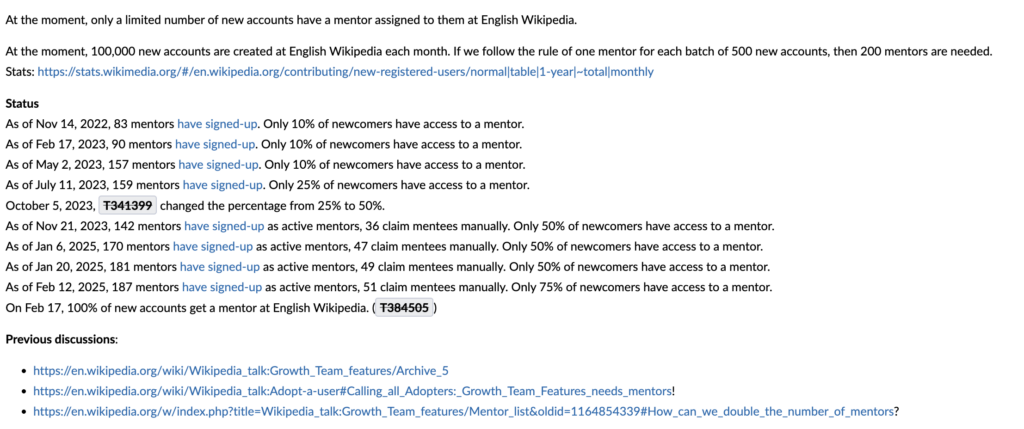
According to its own data:
- English Wikipedia gets 100,000 new accounts each month
- The website program uses a 1:500 mentor-to-mentee ratio, meaning it needs 200 new mentors every month to support its program
- On Nov 14, 2022, it had 83 mentors signed up, and 10% of newcomers had access to a mentor.
- By Feb 12, 2025, it had 187 mentors signed up, with 51 newcomers claiming mentors manually, and 75% of newcomers having access to a mentor overall.
- By Feb 17, 2025, the site had achieved 100% of new accounts getting a mentor for the English Wikipedia
All told, it took Wikipedia 7 years to create the foundation it needed to give everyone a mentor. Funny enough, “Everyone deserves a mentor” is a strong belief at MentorcliQ, so digging into Wikipedia’s mentoring program was natural on our part.
How does Wikipedia structure its mentoring program?
The program is managed by the Wikimedia Foundation’s Growth Team and runs on a volunteer pool of approximately 150–200 active mentors at any given time.
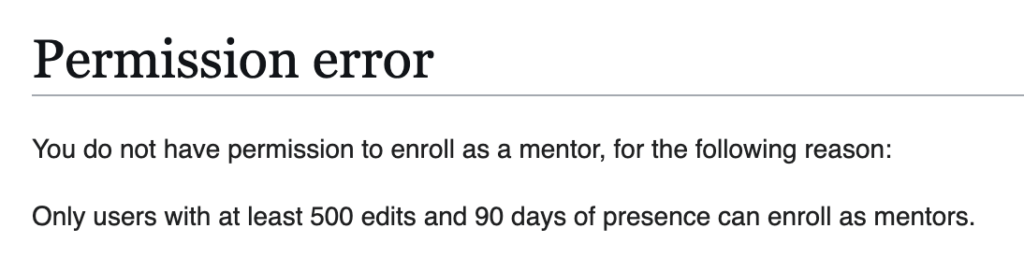
To qualify as a mentor, an editor must have made at least 500 mainspace edits and have held an account for a minimum of 90 days — thresholds that ensure mentors have enough platform experience to actually help. That means as a new Wikipedian who has no publications or edits, I don’t qualify (sad face).
The core mechanism is straightforward:
- New editors ask questions on their talk page; mentors respond.
Wikipedia even maintains a dedicated guidance page walking new editors through the relationship:
- How to contact their mentor
- What to do if a mentor doesn’t respond within a few days
- How to request a reassignment if the relationship isn’t working.
For a volunteer-run project with no budget for HR, it’s a remarkably thoughtful structure. And the underlying logic is sound: complex environments require human guidance, not just documentation. A help center answers questions people know to ask. A mentor answers the questions they didn’t know they had.

All told, Wikipedia is doing everything the right way:
- Operating from a philosophy that every new hire (new account) gets a mentor
- Automatically assigning mentors on the first day
- Utilizing a centralized system to ensure that mentors and mentees can communicate
- Providing resources for mentors and mentees to understand how to navigate their relationship
- Offering tools for mentors and mentees to enter and leave the mentoring relationship as needed
What Wikipedia Got Right About Its Mentoring Program
Before getting into where the model needs extending, it’s worth acknowledging what Wikipedia got right. Each of these design choices reflects genuine wisdom about how people learn in unfamiliar environments and the specific value needed to ensure proper platform adoption, which was the guiding factor behind launching the program.
Everyone gets a mentor automatically
Wikipedia didn’t make mentoring a resource for the most engaged newcomers. It made it the default. That matters because the people who most need support are often the least likely to seek it out. Defaulting to “mentored” rather than “unmentored” is the right design decision.
Mentors are credentialed by experience
The 500-edit, 90-day minimum isn’t arbitrary. It ensures mentors have been through the learning curve themselves. They know what it feels like to be new, and that they’ve developed enough judgment to guide someone else. This is experience-based credentialing, not a formal title or even specifically tenure-based. You could have someone who’s been a user for 2 years with 500 edits and someone who’s been a user for 90 days with 500 edits; both meet that requirement.
The relationship is human and async-friendly
Wikipedia’s mentoring isn’t a scheduled 1:1 on a calendar. It’s a standing resource that makes someone available when a question comes up. That mirrors how much real knowledge transfer happens on the job: not in structured sessions, but in the moment a problem arises. That’s why onboarding buddy programs work so well.
The structure acknowledges that relationships can fail
Wikipedia’s guidance page explicitly tells new editors what to do if their mentor doesn’t respond, and provides a reassignment path. That’s honest program design. Not every match works. Having a clear off-ramp prevents a bad match from becoming a reason to disengage entirely. And with a system that relies heavily on volunteers and matches without specific criteria to ensure relationship success, there’s going to be a high rate of failure, as both mentors and mentees fail to engage, or many engagements that do happen aren’t smooth.
Positively, Wikipedia keeps everything public, so every mentor-mentee interaction is public record. Conversations with mentors go on each account user’s Talk page, which limits the risk of abuse.
Where Businesses Need to Go Further Than Wikipedia with Their New Hire Mentoring Programs
Wikipedia’s program is genuinely impressive for what it is: a lightweight, volunteer-run system that gives every newcomer a human touchpoint. But “lightweight” is both its strength and its limitation, especially for businesses that want to replicate this type of structure.
At the enterprise level, the stakes are different — and so are the requirements.
Matching by criteria, not just availability
Wikipedia’s mentor assignment is automatic in the sense that it’s random: new editors are matched with whoever is next in the mentor queue. That works when the shared context is “we both edit Wikipedia.” It breaks down quickly in an organization where the new hire is a nurse entering a hospital system, a sales engineer at a SaaS company, or a financial analyst at a bank.
At the enterprise level, a strong mentoring match is built on shared dimensions, such as:
- Role or function
- Career goals
- Skill development needs
- Communication style
- Location
- Personality
A new hire in healthcare leadership doesn’t just need someone who’s been at the company longer. They need someone who understands the clinical environment, has navigated similar career decisions, and can speak to the specific challenges of that role. The difference between a well-matched relationship and a random one is evident in retention and engagement outcomes.
This is exactly what MentorcliQ customers see on a participant-versus-non-participant basis, where companies typically see around 32% reduction in turnover for those who participate in mentoring programs, versus those who don’t.
Effective enterprise mentoring programs use structured matching criteria that leverage algorithmic matching to build relationships that are relevant from day one. That specificity is what drives the productivity and retention outcomes organizations actually need.
Read more about the matching options available in the MentorcliQ platform, including our proprietary Smart Match feature.
Structure with milestones, not just availability
Wikipedia’s mentoring relationship has no formal timeline and no curriculum. That’s appropriate for a voluntary contributor platform. It’s not appropriate for an organization trying to move a new hire from onboarding to productivity within a defined window.
Enterprise onboarding mentoring programs benefit from built-in structure:
- Defined meeting cadences
- Milestone check-ins at 30, 60, and 90 days
- Goal-setting exercises
- Guided conversation frameworks
Structure doesn’t eliminate the relationship. Instead, it protects it from drifting into vague good intentions that never quite happen.
MentorcliQ has multiple features that aid structure, including context-aware SmartSteps, which help mentors and mentees maintain active relationships by suggesting next steps along the relationship pathway.
Measurement and accountability
Wikipedia has no mechanism to know whether its mentoring relationships are working. Mentors might respond promptly or go quiet for weeks. New editors might find the relationship valuable or barely notice it existed. There’s no way to know at the program level.
Enterprise organizations can’t operate this way. Effective mentoring programs track participation rates, relationship quality, milestone completion, and — ultimately — business-impacting factors like retention and mobility. Mentoring ROI is a key driver for helping executive leaders understand the value of employee engagement and development programs.
Without measurement, a mentoring program is a morale initiative. With it, it’s a talent strategy.
MentorcliQ offers several ways to gather and explore qualitative and quantitative insights data to prove success, including our ROI Suite for retention data, and our QuickcliQs and Stories features that record mentor and mentee engagement.
Mentor capacity and readiness
Wikipedia’s volunteer pool of 150–200 mentors is serving the entire English-language Wikipedia user base. The ratio works because not every new editor is active. In an enterprise context, the math is more demanding: mentors have full-time jobs, existing responsibilities, and limited bandwidth.
Strong enterprise programs are intentional about mentor selection, preparation, and ongoing capacity management. Mentors who are overloaded become disengaged. A disengaged mentor is worse than no mentor, because the new hire interprets the lack of attention as a signal about how much the organization actually values their development.
That being the case, running a mentoring program incorrectly or without the proper structure can ultimately be worse from an employee experience standpoint than not running one at all. This just means that when you’re ready to start exploring a program launch, you need to do it the right way, and with the proper structure in place to ensure success.
What a High-Functioning New Hire Mentoring Program Looks Like
The Wikipedia framework (every newcomer gets a mentor, matched by experience, supported through a defined period) is the right skeleton. Enterprise organizations that run effective new hire mentoring programs build on that skeleton with:
- Pre-defined program cohorts tied to onboarding cycles, so new hires enter a mentoring relationship at a consistent point in their journey
- Matching processes that factor in role, goals, function, personality, and development needs, not just seniority or availability
- Guided curriculum for the first 90 days: introductory conversations, goal-setting sessions, milestone check-ins, and a defined close or transition point
- Mentor training that prepares experienced employees to guide rather than direct, to ask the right questions, and to recognize when a new hire is struggling before it becomes a departure
- Program measurement that tracks completion rates, relationship quality surveys, and downstream outcomes like 90-day retention and time-to-productivity
When these elements are in place, the numbers are compelling. Employees who participate in structured mentoring programs are retained at a rate 50% higher than those who don’t. In a previous Mentoring Impact Report, we found companies running mentoring programs were 2X as profitable as those without them. And retained more employees.
Those two things are not unrelated. Higher retention = more productivity and retention of critical internal knowledge.
And it’s important to keep in mind that quit quitting is still a thing, so employees who are checked out are functionally absent from their desks, contributing to low productivity numbers and draining profitability.
Wikipedia stumbled onto a structural truth that the fastest way to integrate someone into a complex environment is to give them a human who’s already navigated it. Enterprise organizations have the opportunity to take that truth further through more deliberate matching, more intentional structure, and the ability to measure and improve the program over time.
Building Your New Hire Mentoring Program
My discovery of Wikipedia’s mentoring program was a happy find, but also reflective of a truth MentorcliQ has lived by since its founding. Everyone deserves a mentor, especially at work. The default operation in any business should be “mentored,” not “unmentored.”
The worst thing a new hire mentoring program can be is opt-in only. The people who need it most often won’t opt in. Making a new hire program mandatory is the best way to ensure its success and to see the type of results that executive teams need to see from the program.
From there, the questions about the new hire mentoring program are structural:
- Who are your mentors, and how will you prepare them?
- What criteria will you use to build matches that are genuinely useful?
- What does a 30-60-90-day mentoring arc look like for your organization?
- And how will you measure and report on success?
MentorcliQ is built around exactly those questions. Scientific matching layered on top of human relationships with measurable results is the reason why top-performing companies like Henry Schein, AMD, Cardinal Health, and Dell use MentorcliQ to design, launch, match, and measure new hire mentoring programs that connect people to the right mentor at the right moment in their development. We handle the matching, the structure, the engagement, and the measurement, so program administrators aren’t managing spreadsheets and hoping relationships are happening.
If you’re ready to build a new hire mentoring program — or scale one that’s outgrown its current infrastructure — we’d like to talk.
Modal