
How Manually Run Mentoring Programs Waste Admin Time [2026 Analysis]
WHAT’S INSIDE
I want CliQ Updates!
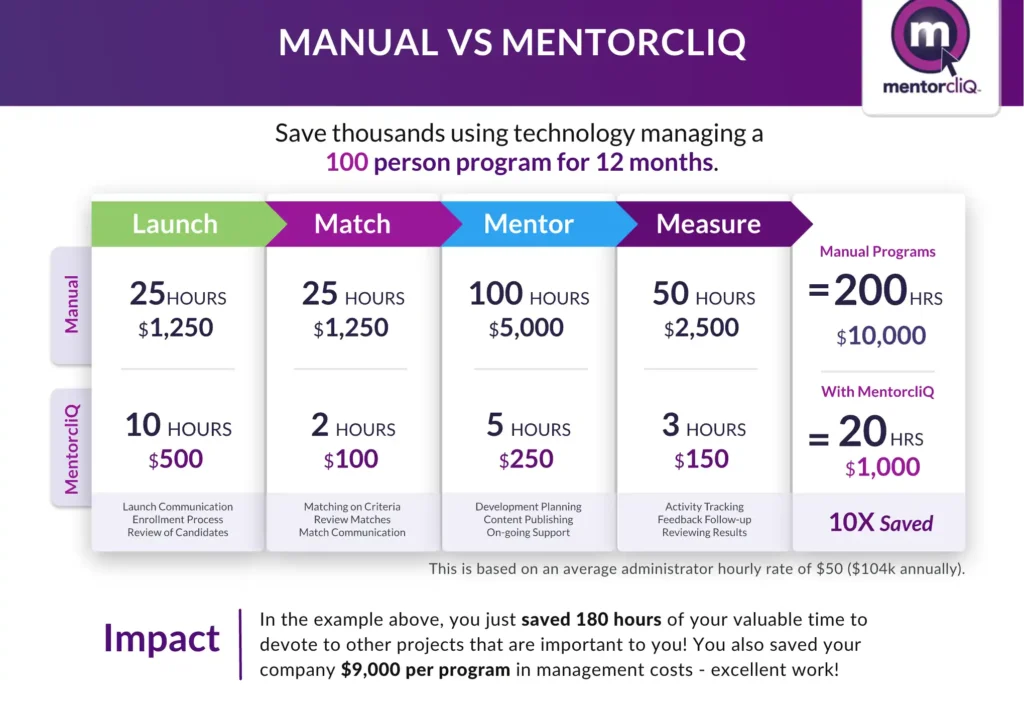
Manually-run mentoring programs waste hundreds or even thousands of hours of admin time, depending on the size and number of your programs. For L&D directors making a bit over $100,000/year (the median L&D salary is around $105k/year, according to ZipRecruiter), that ultimately means managing even one mentoring program with a fully manual approach can equate to over nearly $10,000 in admin time for every 100 hours spent managing the program (keep reading; we’ve got a chart on this one below). That’s pretty much average for how much time you’ll spend managing one program with only a few dozen participants.
The simple answer is you can’t. Not without a legion of admins at your side. And most companies are reducing the size of the HR teams, not growing them. So workloads are only increasing, and every initiative you want to launch that you know will have a positive impact on business goals needs automation, or it’s effectively dead in the water.
In this post, we’ve laid out all of the following:
- Exactly what you need to understand why manual processes for mentoring programs are impossible
- Which areas can be automated
- How to implement automation for your programs in a seamless and cost-effective way
What Do Poorly Structured Mentoring Programs Look Like?
We’ve found the DNA of a a typical, poorly structured mentoring program is pretty consistent:
- The program was launched without measurable objectives
- Executive leaders demanded admins jerry-rig the program to utilize existing tools (such as Workday) that weren’t purpose-built for mentoring solutions
- The program starts small as a “pilot” with only a few dozen participants (if that many)
- The program is run primarily through a very complex spreadsheet workbook that is exceptionally difficult to replicate and impossible to hand over to anyone (meaning if the HR leader running the program leaves, the mentoring program is probably dead in the water).
I hope and pray that doesn’t sound familiar. But we’ve analyzed thousands of hours of sales calls with HR leaders and almost every call where mentoring was running manually is consistent to these themes.
For example, during a demo of our mentoring platform, an HR leader at a pharmaceuticals company told us:
We cannot sustain this. If our company continues to grow, our program continues to grow, we cannot sustain manually matching.
Underscoring this point, a leader at a Retail company exploring automated matching told us:
The problem we have is scaling it and making it to a degree sort of self managing so that I don’t have to constantly keep checking emails going. Let me find you a mentor which is, yeah, just untenable really.
See what these two leaders also saw: automated matching that scales
Get a DemoPoor structure and manual management hobble measurability
Mentoring programs help meet multiple measurable business objectives, but that only happens when they’re designed to succeed. Many HR leaders still manage mentoring programs through a litany of spreadsheets. Starting mentoring programs with a manual approach often makes sense at the start, but manual processes waste hundreds or thousands of hours of work time.
Additionally, manually-run program management significantly limits the size of a mentoring program, reducing scalability ad making it far more difficult to prove the value of the program to executive leaders.
Although any mentoring can support important organizational goals, its day-to-day administration is rarely your or your program admin’s only responsibility. Without the right support and infrastructure, programs quickly stagnate and the objectives you hoped to achieve don’t quite meet the mark.
Mentoring is an easily defensible strategy, but only when you automated as many processes as possible. Companies that automated mentoring programs often find participants have a 50% higher retention rate than those not involved, and a whopping 93% of mentees believe their mentoring relationship was useful.
Mentoring is also one of the few strategies that workers feel positively about. Our July 2026 People Index found that mentoring was one of the few topics workers spoke about on the anonymous public forum Reddit with more positivity than negativity, with a net sentiment score of +21 (compared to areas where employees feel highly negative about, like workload, with a net sentiment score of -77).
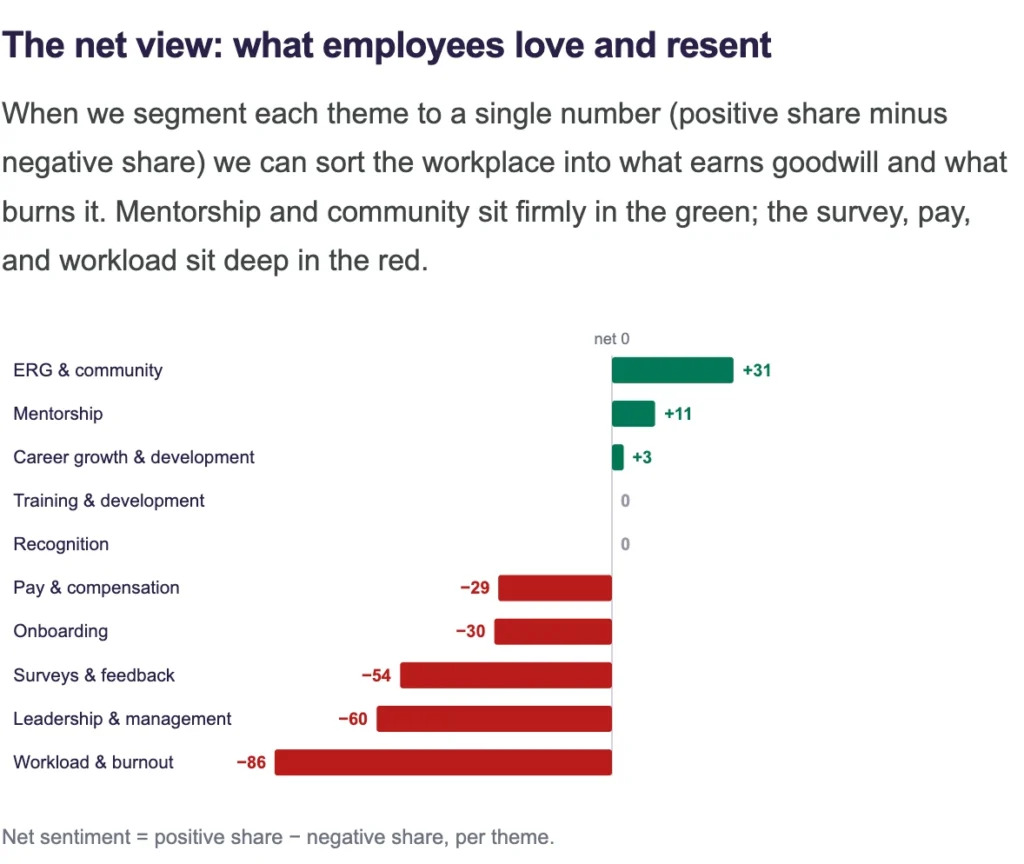
If your manual program isn’t even coming close to success data like this or you’re missing the sentiment gap, you’ll need to start by addressing the most critical issue: the limitations caused by inefficient manual processes.
“I don’t think our mentorship programs are that bad; we have that spreadsheet tracking everything,” you might think.
Repeat after us: Spreadsheets are great at many things, but running a mentoring program is not one of them.
Let’s take a look at some of the key warning signs that you might have a poorly structured mentoring program, not one that is built for success from the beginning.
Matching becomes guesswork
Without structured participant profiles and matching criteria, administrators may have limited information on which to base mentor-mentee matching. An employee seeking support with a transition into management may be paired with a mentor whose experience and interests lie in a completely different area. Both may be willing to participate, but the relationship lacks the common ground needed to become useful.
With hundreds of potential pairs and combinations in even a mid-size business, making matches can come down to vibes and who might appear to go well together. In truth, there is no real rhyme or reason to any of the matches, and therefore no real viability of success.
You don’t have visibility
So, you have paired some people together and logged it in your handy-dandy spreadsheet.
- Are they meeting up?
- Are they having worthwhile conversations?
- Are participants building genuine, productive connections?
You might not know; you just have a spreadsheet.
Roll around feedback surveys, and you realize that measuring program success can’t just be linked to the number of mentoring matches made at the start of the year. Visibility needs to be constant and accessible, not just a general view at the start and end of the process.
There’s no purpose
People can easily connect if you want them to. Throwing names into a spreadsheet, pairing people off, and emailing them that they’re connected is a strategy (sort of), but it’s overwhelmingly ineffective. With no purpose, this turns mentoring into a “nice to have” social interaction, and not a meaningful, purpose-built and measurable connection that is defensible to executive leaders.
If you want to work somewhere specific, the most effective way of making that happen is to reach out to the group you want to work in and find a mentor over there. Be upfront that you are looking for mentoring on what you could do to be a better candidate for that group and by the time they go to open a req, if they like you, they can be lazy and just get you on an internal transfer. Doing it in this way will allow you to skip the interview/competition part of getting the job.
— u/uberleetYO, posting on r/Raytheon, July 2026
The best mentoring programs have some reason or purpose behind them. They could be for onboarding support, or for connecting diverse groups across departments, or even for reverse mentoring where senior leaders learn from juniors. There is no right or wrong way to do mentoring, but it should have substance and purpose if it is to be a success. The moment someone signs up to the scheme, they should have access to resources and guides that will help to inform their actions moving forward.
Administrative burden keeps building
Remember those spreadsheets? If you are tracking everything here, every subsequent action has to be completed manually. You can’t simply press a button and send out an email to the whole mentoring cohort. Data has to be downloaded, rearranged, and interpreted before you can make a report, rather than just using a software tool that creates a report ready to be exported.
Side Note: AI systems like ChatGPT or Claude can help you speed up this process, but you will quickly run up against token limits, hallucination concerns, and internal pushback regarding loading employee data into AI systems.
Relying solely on spreadsheets is always to be a go-to “safe” option, but they will never stop being sill incredibly slow. Before you know it, you don’t just have another task to add onto your day; you have a full administrative job taking up your time.
What Do Strong Mentoring Programs Need to Thrive?
Rather than rely purely on our mythical spreadsheet, we need to think about what we can do to create a strong mentoring program that has everything it needs to thrive. This is not an initiative that you can just launch into your organization without any planning. If mentoring programs are to succeed, they need the right foundation from their inception.
Informed Participants
To feel included, participants actually need to be included. They need to receive regular communication, updates, and information about what is happening within the program. Setting up an email group with everyone involved is a start, but that is just one more admin process and one more chance for someone to be lost and forgotten.
Mentors and mentees alike need to know about the opportunities afforded to them via mentoring programs. From the moment they sign up, participants should have access to resources that help them develop leadership capabilities, build new skills, and make productive use of the mentoring relationship.
Willing and supported program coordinators
A mentoring program can’t feel like a burden. We all have a stack of tasks to complete at work, and it can feel frustrating when another is added to the mix. For that reason, we must choose the right people to handle the administrative work that comes with a mentoring program. They must be willing to see it succeed, to understand the role they play in bringing it to life.
However, support also needs to come from the organization too. Program coordinators need to be given the tools and resources they need to manage mentoring effectively so that this task doesn’t overtake their other responsibilities.
Dedicated software
The easiest way to facilitate open and effective mentoring is through the use of dedicated mentoring program management software. The right tool should act as the home for your mentoring for all: for mentors, mentees, and the administrators working behind the scenes to bring the program to life.
Having the right software truly makes everything more straightforward. If you feel like spreadsheets and manual processes are hindering, not helping, your organization’s mentoring scheme, something needs to change. All the good that can come from mentoring—employee engagement, improved confidence, skill development—will struggle to flourish if other issues are holding it back.
Why the Right Mentoring Software Helps Your Admin Teams
Let’s return to the four points we raised earlier about what poorly structured mentoring programs look like. How can dedicated mentoring platforms address each one?
Matching is automated, and without bias
Choosing to let an algorithm take care of matching criteria means that there isn’t a load of guesswork when putting together pairs. The software can look through mentors and mentees, without bias, and put together pairs that will best meet their individual strengths and goals.
Just think of this from a speed perspective; a program admin may only be able to make a few good matches a day, while the right software uses smart matching to pair people together almost instantaneously.
Get a live demo of MentorcliQ’sautomated matching
Get a DemoYou have visibility at all times
The right software gives you access to progress tracking at all times. Since every interaction is tracked in the program from first connection to meeting and more, you actually have visibility over whether or not your matches are successful.
Though employee surveys will always help you to dive into how people actually feel (so don’t discount them!), you should have complete visibility over your scheme at any given moment.
You can tailor your mentoring purpose to your need
Some schemes may have clear ideas of what they want their mentoring to look like. Others may prefer to leave things in the hands of their mentoring pairs to let them define the relationship. Whether you let your mentoring circles take the reins or not, all information will live within the mentoring platform.
HR teams and admin don’t feel the burden
Most importantly, your admin teams will finally be free from the perils of the spreadsheet. With everything handled for them via the software, they can focus on the tasks that actually require their attention.
On top of this, HR teams can quickly and easily report on program health. Rather than ask repeatedly for access to the magical spreadsheet, or just a chunk of data from one specific part of it, they can just log on and download what they need at the push of a button. Clarity and confidence in a flash.
Explore What MentorcliQ Can Offer Your Mentoring Admins Today
If you feel your mentoring admin staff are struggling with their workload, it is time to explore alternatives. Break free of the spreadsheets and the manual matching and find a better solution. Software like MentorcliQ’s mentoring platform is designed to centralize the matching, communication, tracking, and reporting involved in employee mentoring.
Still not convinced? Download our guide, The Dark Side of Manual Mentoring to get additional insights and pain points we hear from HR leaders running programs manually and explore how the right software can transform your organization’s approach to mentoring for all.
Modal