
From Mentoring to People Networks: The Future of Workplace Connection
WHAT’S INSIDE
I want CliQ Updates!
The future of workplace connection isn’t about creating more programs. It’s about creating more pathways for and to people.
Most organizations have no shortage of ways for employees to communicate with one another. Emails. Slack messages. Teams chats. Town halls. Intranets. Meetings. Employee events. Mentoring programs. ERGs. Communities of practice.
And yet, people can still feel disconnected, because communication and connection aren’t the same thing.
Gallup’s 2026 research found that only 20% of U.S. employees strongly agree they feel connected to their organization’s culture. What’s more, employees who do feel connected to their culture are significantly more likely to be engaged and less likely to be looking for another job or experiencing frequent burnout.
Employees can be surrounded by people all day and still feel like they’re navigating their careers alone. The future of workplace connection may not be about creating another program, another platform or another channel. It may be about helping employees find the right people and rethinking what mentoring and employee communities are designed to accomplish.
Connection Isn’t a Location Problem
For years, workplace connection has been closely tied to where people work. Remote? Find ways to connect. Hybrid? Create more opportunities to collaborate. In-office? Encourage more interaction.
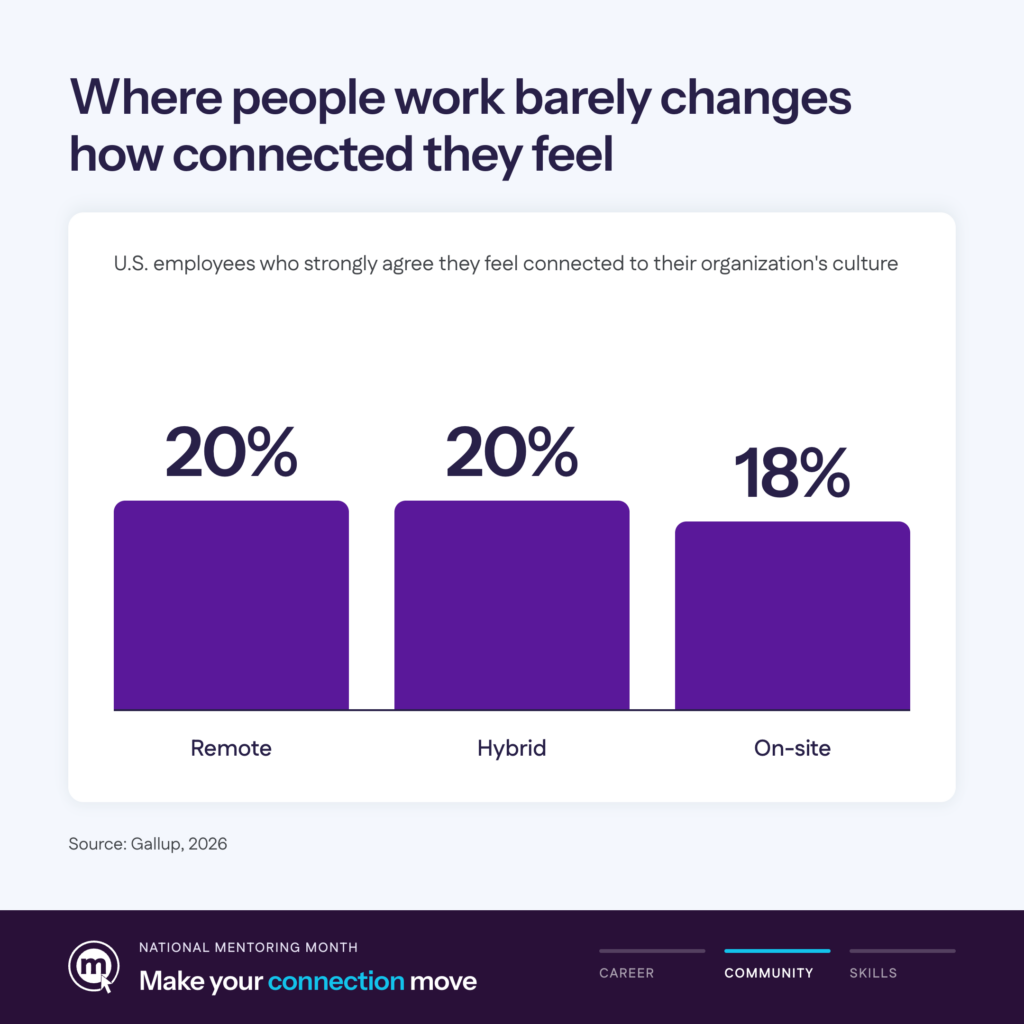
But Gallup’s latest data tells a more interesting story. Only 20% of remote employees, 20% of hybrid employees, and 18% of on-site employees strongly agree they feel connected to their organization’s culture.
The difference is minimal, so perhaps the bigger question isn’t: Where are our employees working?
It’s: Who are our employees connected to?
Connection isn’t created by proximity; it’s created by relationships. The person sitting next to you may never become someone you turn to for career advice. Meanwhile, someone three departments away—or three time zones away—could become the person who helps you see your career differently.
That distinction matters for leaders thinking about employee experience. Bringing people together can create opportunities for interaction, but meaningful connection takes something more intentional.
People need opportunities to find people they can learn from, relate to, collaborate with and grow alongside.
Employees Need People, Not Just Programs
Think about a meaningful moment in your own career.
Was it a training course? A development plan? Chances are, however, some of the moments that really changed your direction involved another person.
A manager who encouraged you to raise your hand. A colleague who made an introduction. A mentor who helped you prepare for a difficult conversation. An ERG leader who made you feel like you belonged. A subject-matter expert who helped you understand something you’d been struggling with.
Or maybe it was simply someone who said, “You should go for it.”
Those moments matter because people don’t experience work as organizational charts. They experience it through relationships.
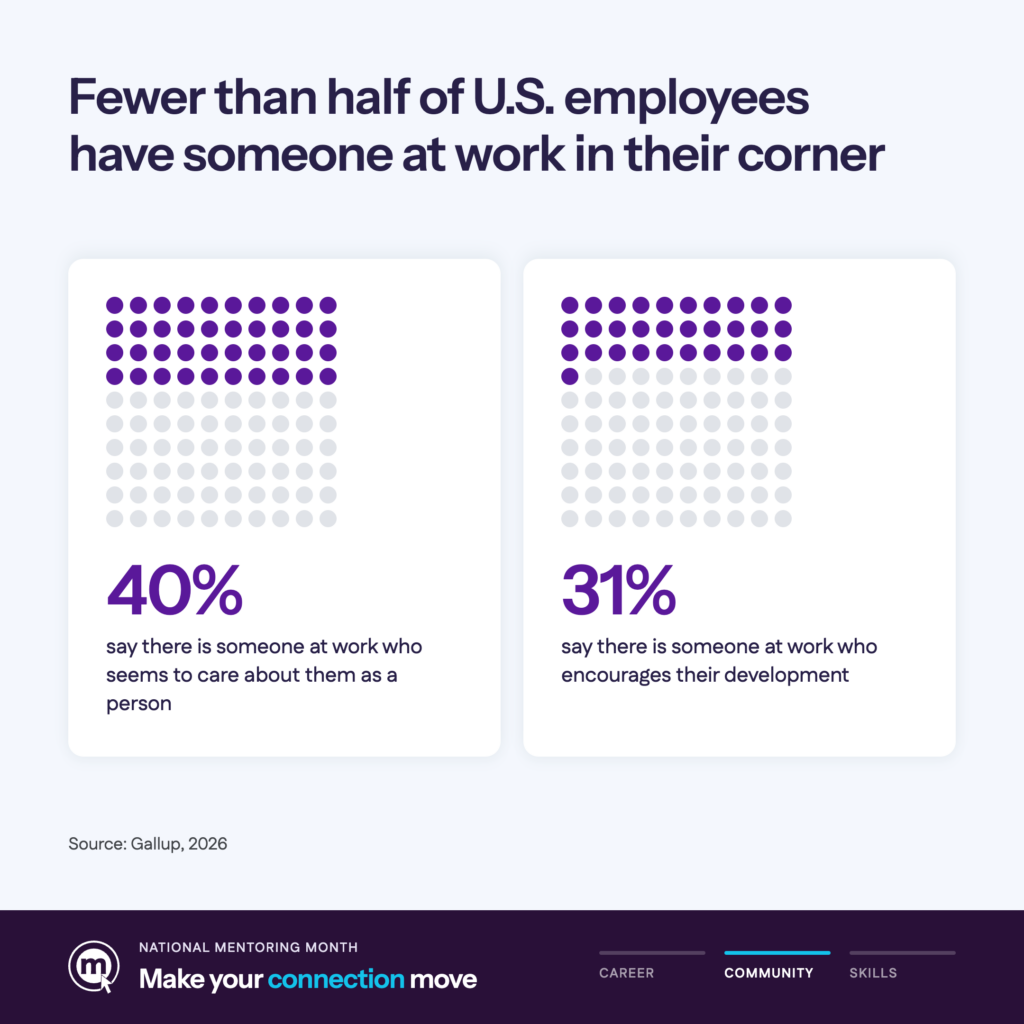
Gallup’s 2026 Employee Engagement data reinforces just how important those relationships can be. Only 40% of U.S. employees say there is someone at work who seems to care about them as a person, while just 31% say there is someone at work who encourages their development.
For HR, L&D and talent leaders, that’s more than an engagement statistic. Employees don’t just need access to information. They need people who can help make that information meaningful.
A career development resource can tell someone what skills to build. A mentor can help them figure out which skills matter for their goals and how to apply them. A learning program can teach. A community can help someone put that learning into practice. A career framework can show someone where they could go.
A relationship can give them the confidence to take the first step.
From Mentoring Relationships to People Networks
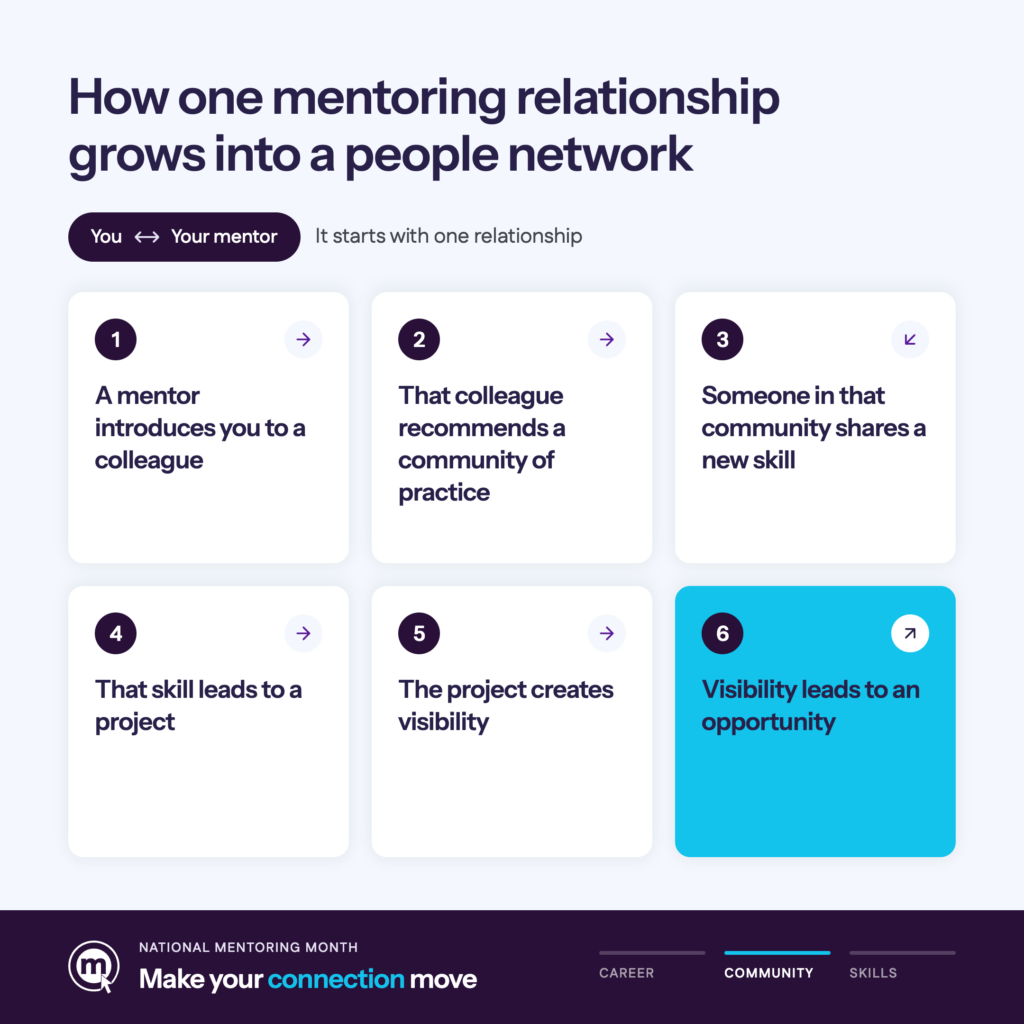
Traditional mentoring is often pictured as a simple relationship:
Employee ↔ Mentor
That relationship can be incredibly powerful, but what happens when that relationship becomes a doorway to something bigger?
- A mentor introduces an employee to a colleague.
- That colleague recommends a community of practice.
- Someone in that community shares a new skill.
- That skill leads to a project.
- The project creates visibility.
- The visibility leads to an opportunity.
Suddenly, the original mentoring relationship has helped create an entire network of possibility. That’s the shift from mentoring relationships to people networks.
The employee isn’t simply gaining a mentor. They’re gaining access to people, experiences, knowledge and opportunities they may never have encountered on their own. This is increasingly important as careers become less linear, skills continue to evolve and opportunities exist well beyond an employee’s immediate team or function.
The question becomes less about:
“How do we match this employee with a mentor?”
And more about:
“How do we help this employee find the people who can help them move forward?”
Employee Communities Can Become Connection Hubs
This is where employee communities become especially interesting. ERGs, communities of practice, identity networks and experience networks aren’t simply places for employees to gather.
At their best, they can become connection hubs. A community can help an employee find someone with a shared experience. A community of practice can help them find someone with a skill they’re trying to build. An ERG can introduce them to people outside their immediate department. An experience network can help someone navigate a life or career transition with people who understand what they’re experiencing. And mentoring can create an intentional relationship that helps employees turn those connections into development.
That’s part of the opportunity behind CommunityCliQ.
CommunityCliQ helps organizations support employee communities, including ERGs, communities of practice and other employee networks. The bigger idea isn’t simply giving employees another place to participate.
It’s creating more ways for employees to find their people, build relationships and discover opportunities. The goal shouldn’t simply be to help employees belong to a community; it should be to help them move through it.
What People Networks Make Possible
Imagine an employee who wants to make a career move. Instead of searching through an organizational chart and hoping they find the right person, they can discover someone who has made that move before.
An employee wants to develop AI skills. Instead of simply assigning another course, they can connect with people already applying those skills.
Someone wants to find a greater sense of belonging. Instead of sending them another engagement survey, they can find a community where shared experiences create meaningful relationships.
Someone is considering leadership. Instead of waiting for a promotion cycle, they can connect with mentors, leaders and peers who can help them understand what leadership looks like—and whether it’s the right next step for them.
That’s what a people network can create:
- Find someone.
- Find a community.
- Find a skill.
- Find an opportunity.
- Find what’s next.
And sometimes, the most important thing an organization can give an employee isn’t another resource.
It’s a relationship.
Mentoring Can Be the Connector
This doesn’t mean mentoring needs to become everything.
Mentoring can become part of something bigger, with a strong mentoring relationship creating intentional connection. Employee communities create broader networks, communities of practice create knowledge-sharing opportunities, and ERGs create spaces for belonging and shared experience.
Together, these experiences can create something organizations increasingly need: a workforce that knows how to find the people who can help them move forward.
That becomes especially powerful when employees are navigating change. When everything around you is changing, knowing who you can turn to can be just as valuable as knowing what you need to learn.
Mentoring can help employees build the confidence to ask questions, explore possibilities and take action. Communities can expand the number of people they can learn from. This combination can turn an individual development experience into a broader network of opportunity.
Five Questions for Rethinking Workplace Connection
For HR, L&D and talent leaders, the shift from programs to people networks creates some important questions.
- Are employees able to discover communities and relationships outside their immediate teams?
- Can mentoring connect employees to broader networks rather than existing only as a one-to-one experience?
- Are ERGs and communities of practice connected to learning, skills and career development?
- Do employees know where to find people who have the experience or expertise they’re looking for?
And perhaps most importantly:
- If an employee wants to make their next move, do they know who to talk to?
These questions move the conversation beyond program participation. The goal isn’t simply to give employees more places to go, it’s to help them find more people who can help them get where they’re going.
The Future of Workplace Connection Is a Network
Mentoring isn’t going away. Neither are ERGs, communities of practice, employee networks or professional development programs.
The opportunity is to stop thinking about them as isolated destinations.
Employees don’t experience their careers in separate boxes. They move between people, experiences, communities, skills and opportunities. A mentor can open a door, a community can help someone walk through it, a new skill can create another opportunity, and another relationship can change what’s possible next.
That’s the power of a people network.
The future of workplace connection isn’t about creating more programs.
It’s about creating more pathways to people.
Sometimes your next move starts with a conversation, and the person who helps you make that move is someone you never would have met without the right connection.
This National Mentoring Month, let’s rethink what connection can look like and how mentoring and employee communities can help people find the relationships that move them forward. Make Your Connection Move.
Book a demo with MentorcliQ today, and let’s discuss how our award-winning platform can help you rethink connection in your organization.
Modal